Showing posts with label Parrot care. Show all posts

Sunday, March 16, 2014

The Parrot Diaries: First Rule of Finding Yourself in a Hole: Stop Digging


Most people are familiar with the old Will Rogers axiom: When you find yourself in a hole, stop digging. The parrot equivalent should be: When you find yourself on a perch, stop chewing. Our Ruby macaw Mr. Cracker is a portable woodchipper. He loves to chew. At least once, that we know of, he's chewed through his perch. While he was sitting on it. You'd think he'd learn. But the experience hasn't stopped him from chewing through his perches.


To make our life easier, we decided to start using two by twos for Mr. Cracker's perches. They fit his big feet perfectly. We started with pine. Big mistake. That lasted about two days. So we switched to fir. Much harder wood. Much harder for Mr. Cracker to chew through his perch. Not that it stopped Mr. Cracker from trying to chew through his perch. He just had to work at it harder. The perches last longer. We're talking weeks instead of days. We try to catch the perch before he manages to chew through it. And switch it out with a new one. Not horribly expensive. And the old perch gets sawed up for chew toys.


And we keep hoping that some day Mr. Cracker will stop trying to chew through his perch and focus on chewing his chew toys instead. We can always dream.


Wednesday, July 24, 2013

Cockatoos Are Not Suitable to Be Companion Parrots

We are macaw parrot people. Our experience with cockatoo parrots is limited to our male Goffin's cockatoo, Kid Kadra, a parrot juvenile delinquent if there ever was one. Recently, we were contacted by a parrot person living outside of Seattle who is having problems dealing with her cockatoo parrot Conan. Caitlyn is an experienced parrot person. In addition to her cockatoo, she has a flock including three conures, a Meyers, and a lovebird. As Caitlyn notes: I had worked with cockatoos prior to obtaining Conan but had never lived with one. Point being, I didn't go into this with zero experience, but he's the first large parrot that I have owned.

The Ideal

In spite of her parrot experience, Caitlyn developed serious issues with Conan. She contacted us looking for advice. We are putting her story out to the cockatoo parrot people in our audience. Stories like Caitlyn's reinforce our belief that cockatoo parrots simply are not suitable to be companion parrots.

Here is Caitlyn's situation:

I have an umbrella cockatoo, Conan. He is fifteen years old, and we know little of his history but from what we've heard, we assume that we are his third home. I got him from a couple who decided to rehome him because both of them worked full time jobs and, less importantly, he was sort of a screamer.

I brought him home to my parent's house, where I will live for another couple of years to finish my degree. He was cuddly as could be, though we were careful not to cuddle too much, and he screamed about as much as expected. He was in a relatively peaceful room with the other birds at the time. After he started to scream excessively, we brought him into the dining room where there is a lot of activity all day. He stopped for a couple of weeks.

Conan comes out of his cage daily, goes for rides in the car, and is supplied with toys 24/7. He's on a diet of pellets and occasional fresh food. He interacts with all members of the household. It seems as if he should be a rather happy bird. However, his screaming is once again becoming excessive. He used to do it only when nobody was in the room with him; however, now if he's in the mood (which tends to be every other day on average), he will scream regardless of how many people are in the room. He is given a warning, "no screaming," followed by a "time out" where his cage is covered for about a minute or until he stops. We've been doing this for about a month and have seen no difference in the frequency and he never heeds the warning.

Two of us work from home and are on the phone often. We have had to give up on the phone call several times because Conan's favorite time to scream is when we are talking to someone else. If it were only me, I would grin and bear it, but it's both of my parents, too. They have been tolerant so far, but they are reaching the end of their patience.

The more recent big problem is aggression. I'd expect it in the spring, but it is mid-summer now and shouldn't be this bad. He wasn't aggressive before and the previous owners didn't mention anything about it, but in the past month he has bitten me for anything from misplaced aggression, fear, a desire to go and run around on the floor, an aversion to going back into his cage, or just seemingly out of nowhere. He continues to be sweet and sociable most of the time, but I can't have him out without expecting to be bitten at some point. I consider myself to have a high pain tolerance, and I do not get nervous around him, but I can't live with this pattern of aggression for presumably the rest of my life.

Today was the closest I've ever come to a "straw that broke the camel's back" moment. Earlier in the day he had taken a small chunk out of my finger when I attempted to fix his water bowl, but that was of little concern. Later, I came home from errands and opened his cage, intending to take him out for a while. Instead of happily stepping out like normal, he lunged at my hand in a way that absolutely cannot be mistaken for anything but aggression. I've had him use his beak to balance before, and it's very different - this time his crest shot up and his tail fanned out and he jumped at me. On the floor, he ran after my feet, and when I crouched down to try to coax him onto my hand he lunged at my hands once again. I sat on a barstool while he climbed back up onto his cage. Completely confident in the notion that he would now step up from his cage (as he has done for the six months or so that we have had him. Even if he is grumpy on the floor, he always comes nicely from any spot on top of his cage) I walked over and offered him my arm in a deliberately slow way so he would not get excited. With no warning, he jumped at my head/chest/arm and when he missed, climbed back into his cage, proceeding to try to take off my fingers as I locked the cage door.

I just don't know what to do now. If this continues for even another day, it's going to become very hard to take care of him. As I said, I can't live with a large bird that behaves this way and I can't subject my family to it for another two years. I think if it was just the screaming, it might be manageable, but the biting has caused me to seriously think about whether I can keep him. I believe 100% in giving my birds a forever home, but maybe I'm in over my head with Conan. Obviously I'm at my wit's end, since I'm looking up rescues in the area. I really don't want to rehome him just so that yet another family can decide that he is too high maintenance; at the same time, I question whether this is the best place for him. He can't be happy if he's acting this way.

The Reality

I would really appreciate your advice on the matter. Giving him up is a last resort, but we're getting to that point.

Any advice for Caitlyn and Conan? We promise to pass it on.

Sunday, July 14, 2013

Disposable Parrots, Part Two

Get tired of your parrot? Just leave him behind and move out.


Sunny is a presumed male Blue Crowned Conure parrot approximately ten years old. Sunny's caretaker reports:

I arrived home in Seattle from vacation to find that my roommate, Sunny's parront, had left town and abandoned his bird. I cannot care for the bird and need to find a foster family for this bird as soon as possible. My roommate appears to have had some kind of mental health breakdown and has not contacted me, any family, or any mutual friends since he left. He has forfeited the parrot's care. 


Sunny is friendly and has always been friendly around people. I have been living with this bird for about six months and he will step on my finger when told "step up," fly to my shoulder, and return to his cage. He is a bit lazy and doesn't fly far. He had a Green-cheeked Conure sharing his cage for many years, and the little bird plucked out his feathers. He plucks too. He has been fine around my dog and only nips or screams when frightened. He says "hi" most often. I think he knows other words but he mostly just makes noises.

Postscript: Sunny's caretaker contacted Northwest Parrots Fund, a 501(c)3 nonprofit charity in Seattle dedicated to finding homes for unwanted and homeless parrots. Northwest Parrots was able to place Sunny in a happy parrot home with a flock of parrots including another Blue Crowned Conure parrot.

Saturday, April 6, 2013

If Life Gives You Lemons, Just Make Your Own Beach


However erudite, well mannered, and communicative our parrot companions are with us, especially our African grey parrot companions, they are still wild animals at heart. It would be better for them and us if they were all living their wild lives out in the wilds of Africa, and wherever else they originated. Unfortunately for them and us they are not and never will. So we just have to do the best we can for them. Make their lives as companion parrots as fulfilling, safe, and carefree as it is possible to make. Then we just hope that in our next lives we don't come back as a parrot stuck in a cage!

Thursday, February 28, 2013

Ballard Parrot Works


Any parrot person who has flipped through the pages of a parrot catalog recently or checked a website online knows that prices for parrot chew toys are insane. And that's just for the small and medium parrots. Imagine if you live with five macaws like we do! Trying to keep the parrots in chew toys chews through a paycheck in no time at all. And this is for toys that are intended to be destroyed!

So we decided to start building our own parrot toys and trade some of our time and elbow grease for money. We made a small investment in some necessary tools, like a Skill saw for $30 and a Hitachi drill for $40 to start. Got some 2 by 2s and 2 by 4s, some stainless steel chains, and set up a work table in the garage. The Ballard Parrot Works was open for business!

With our macaws stainless steel chains are a requirement. At one time we tried using rope, which lasted about ten minutes under a macaw beak. We like to use ring fasteners to secure the chew toys on the chain because they tend to be parrot proof and they easily come on and off when it's time to add new chew toys.


We can also assemble simple toys with a stainless steel chain and some plastic balls and rings which keep our smaller parrots happily entertained for hours at a time. Our Congo African Grey parrot Arua obsesses over this toy. She finally chewed her first one to pieces, so we assembled another one. We believe that she thinks there must be a way to take the rings off of the chain. She's determined to figure it out!


With time and experience we'll figure out what kind of tools and materials work best for our parrots. For now we're having a great time building toys in the garage. And the results speak for themselves.

Our Greenwing macaw Roxanne eyeing her new string of chew toys as she decides how best to destroy it!

Sunday, September 9, 2012

Don't Break That Door!

Arua

Our first Congo African grey parrot was a crusty male rescue parrot named Corky who spoke little in the way of understandable English. However, one of his few phrases was: Don't Break That Door! He liked to slam his cage door shut, so he probably heard that quite abit in his short life. After Corky died from cardiac arrest in 2006, we acquired another Congo African grey. This one a female named Arua.

Arua Upside Down

Arua also likes to slam her cage door shut. However, she didn't say Don't Break That Door! So, as homage to our beloved Corky, we decided to train Arua to say: Don't Break That Door!

Arua easily picks up the words and phrases she wants to pick up. You Done Yet? I Want Apple! Watch Your Tail. I love YOU! Go poop. Come here missy. Tara, Tara, Tara, TARA! But year after year she refused to say Don't Break That Door! Even though we constantly repeated that phrase to her.

Recently, we heard a couple of garbled words that sounded strangely like Don't Break! Although at first it sounded more like What Break.

As we listened, and as Arua practiced the words, Don't Break became more and more apparent. Success! Now we just need to get her to complete the phrase.

Corky


Saturday, May 26, 2012

The Perfect is the Enemy of the Good


A couple of events recently, both involving parrot sanctuaries, have got us thinking about the state of the parrot rescue movement these days. One event in the United States. One in Canada. In the United States, the Wings Over the Rainbow parrot sanctuary in Ohio closed when humane society officials seized more than 100 parrots from the sanctuary, alleging cruelty and neglect.


In Canada, one of the largest parrot sanctuaries in North America, the World Parrot Refuge, home to about 800 parrots, located in Coombs, British Columbia, came under attack from parrot advocates for allegedly having substandard facilities and care of its parrots.


We have not visited either facility, so we can't speak to the actual conditions on the ground. But involved in parrot rescue as we are, we have often wondered what our limits are. When does parrot rescue become parrot hoarding? The person who started Wings Over the Rainbow probably never expected to have more than 100 parrots in her care. We damn sure bet the people behind World Parrot Refuge never dreamed when they started they would eventually be caring for 800 parrots!


Parrot rescues and sanctuaries exist because people acquire companion parrots for all the wrong reasons. We won't get into a discussion here about whether parrots are even suitable to be pets. We've come to the conclusion that they aren't. Parrots are not like dogs and cats. Essentially they are wild animals. Wild animals with the intellectual development of a three to five year old human, and the emotional development of a two to three year old. Wild animals that can live fifty to eighty years, and even more! As parrot owners age, and as the economy flounders, people who once thought they could provide forever homes for their companion parrots are discovering otherwise.


So how is it that parrot rescue devolves into parrot hoarding? The urge and inclination is to attempt to save every parrot that needs a new home. How do those of us working in parrot rescue know our limits and know where to draw the line? For a devoted parrot person being able to say No can be the hardest thing in the world to do. Any person involved in parrot rescue needs to understand that we can't save every parrot that comes to us. Attempting to do so may jeopardize the parrots already in our care.


When we acquired our first parrot, our Greenwing macaw Roxanne, we only ever expected to get just the one. Next thing you know we adopted a female Blue and Gold macaw, Bubba Boy, that was bound for a parrot breeder. We still didn't know much about parrots and nothing about parrot breeders, but we had the feeling that placing a companion parrot with a breeder was not an ideal situation. Once we acquired a couple of parrots, then people started dropping parrots on our doorstep. Literally. Someone dropped a male Blue and Gold macaw, Aboo, in our care for a weekend, and never returned to pick him up. Later we learned the parrot was considered unmanageable. Then we ransomed a Hyacinth macaw, Princess Tara, from a deplorable bird store situation. And on. And on. And on. People begged us to take their parrots to find new homes, warning dire consequences for the parrots if we refused. So we did. And we started searching for new homes. Before we even realized it, we were running a parrot rescue.


Where to draw the line? Over the years our learning curve regarding parrots and parrot care has been steep. We've come to appreciate who the true parrot experts are, and the best sources of information for parrots and parrot care. Probably the most important thing we ever learned was that we did not hold a monopoly on parrot knowledge. We quickly realized that in finding new homes for companion parrots in need of new homes we had to trust that the people adopting the parrots would ultimately be able to care for them. Otherwise we'd never feel confident enough to release parrots to others for adoption. And we'd be stuck with a house crammed with parrots from basement to attic. That was a situation we clearly wanted to avoid. Becoming a parrot hoarder instead of a parrot rescuer!


Parrot rescue becomes parrot hoarding when the parrot rescuer starts to confuse the perfect homing situation for the best homing situation for the parrot. It appeared to us if a parrot rescuer became obsessed with finding the perfect forever home for the parrots in their care, the parrots would never be rehomed. By definition, the perfect forever home can never be found. Parrot sanctuaries that claim to provide a forever home for their parrots are living a myth. We can't begin to count the number of parrot sanctuaries that have closed their doors for various reasons over the past several years.


One last gripe. Parrot rescues and sanctuaries are seemingly obsessed with forms and procedures. Any lawyer will tell you that a contract is not worth the paper it's printed on if the contract is not enforced in court. And even then it's dubious. Sometimes it seems to us that parrot rescues and sanctuaries build paper walls around themselves as a means to buttress the myth of the perfect and keep the parrots in their care from ever being rehomed. Thus does parrot rescue devolve into parrot hoarding. Our suggestion? Focus more on finding suitable homes for rescued parrots and less on forms and procedures.


Tuesday, May 8, 2012

Chomp! What Happens When You're Even A Little Bit Careless With a Hormonal Macaw


Ouch!


Never ever take your eyes off of a hormonal macaw when handling said macaw!


If you'd like to know what my thumb feels like,imagine putting your thumb in a vise and clamping the vise shut. It's something like that. No wait. It's exactly like that! The lesson here is: Always remember to respect macaw beaks.


Sunday, November 13, 2011

Words Escape Us! How Can Anyone Do This to a Parrot?

Francine is a presumed female, Very Special Needs Blue and Gold macaw parrot, in need of a home in the Seattle area with a very special parrot person, someone with prior macaw experience.


Francine was surrendered to Zazu's House Parrot Sanctuary outside of Seattle, with no history. She arrived at the sanctuary with broken wings, broken feet, and seriously underweight. She has severe plucking issues. She needs a home with an experienced macaw person, who can provide the special environment and extra care that Francine needs to thrive and flourish. Francine comes with no history and no records. Nothing is known about her background or her age.

Because of her broken wings and broken feet, Francine can not fly or climb.

This is as much as Francine is able to extend her wings.

If you are interested in adopting Francine,
please contact Northwest Parrots Fund.

Friday, October 21, 2011

Feeding Parrots: Making Toast Française

Are your parrots tired of eating Chop and Mash day in and day out? Make them some real food! Toast Française for example is pathetically easy to make. And your kitchen smells so good after you fry up a batch you won't want to leave the room.


Making Toast Française
(Irresistible to Parrots)


Surprisingly few ingredients are required to make Toast Française. Basically: bread, milk, egg, cinnamon, and whatever you want to use for coating the toast. Crushed pellets, chopped nuts, and cereal come to mind. Our parrots love organic Peanut Butter Panda Puffs! Our parrots are also partial to vanilla soy milk.


1 slice of bread, toasted
1 Teaspoon milk
1 Egg
1/8 Cup Crushed topping
Dash cinnamon


We cook up two slices of toast per meal for our eight parrots, so we double the ingredients, except for the egg.

Our female Timneh African grey parrot Tillie supervising production of one of her favorite dishes. Got to keep an eye on that yolk.

Seriously beat the egg and milk together for about 30 seconds. Really fluff it up! Stir in the crushed pellets, nuts, cereal, or whatever you wish to use, to coat the toast.


Dip the toasted bread in the egg and milk mix. Your parrot will definitely want to supervise this step!


Fry the toast up in a Stainless Steel pan with cooking spray or a touch of vegetable oil. We like olive oil. Let cool, obviously. It's so good you might just want to make some extra for yourself.


Cut up to desired size.


Serve.

Beak Appetit!

Toast Française  is a favorite with parrots large and small. Our foster Ruby macaw Mr. Cracker can't dive into his food dish fast enough to savor his Toast Française!

Tuesday, October 18, 2011

Disposable Parrots

The Truth About Parrots: Best Friends Animal Society


Parrot breeders are a strange lot! If you visit just about any online parrot forum, say Patricia Sund's Parrot Nation, you'll run into parrot breeders in total state of denial (and we're not talking about a river in Egypt). Trying to argue with a parrot breeder about the companion parrot overpopulation problem quickly leads to the conclusion that parrot breeders live in a parallel universe where facts and reality do not apply. In this parallel universe, there is no companion parrot overpopulation problem. In this parallel universe the commercial companion parrot trade does not engender wild parrot smuggling across the Mexican border. In this parallel universe, parrot rescues and sanctuaries are full to the brim with unwanted parrots because the rescues and sanctuaries choose to be. In this parallel universe, discarded and abandoned parrots don't get shuffled around to seven or more homes in their lifetimes. In this parallel universe any parrot needing a new home can find one, if you simply work hard enough!

Parrot breeders are full of . . . (I'll be polite) Parrot Poop.

A thirtysomething female Cockatoo parrot named Simba back when she still had some feathers, currently living at Mollywood Avian Sanctuary. Simba is virtually naked now. A previous owner threw her against a wall and broke her keel bone. In spite of her history of abuse and neglect, all Simba wants to do is cuddle in your arms!

We recently had the opportunity to visit Mollywood Avian Sanctuary outside of Bellingham, Washington, north of Seattle. The number of abandoned and discarded Cockatoo parrots residing at Mollywood is truly heartbreaking. These parrots can never be rehomed. Yet parrot breeders keep breeding Cockatoo parrots because breeders and pet store chains have convinced pet owners of the desirability of hand-fed baby parrots.


We were pondering the question of why there are so many abused, neglected, and abandoned Cockatoos and other parrots when we came across a fascinating article on the Bear in Mind blog just published on PsychologyToday.com, Why the Caged Bird Does Not Sing: Captivity and Post-Traumatic Stress Disorder in Parrots and People, by Gay Bradshaw. Traumatologists have discovered that caged parrots exhibited symptoms identical to humans suffering from chronic victimization:


Severely traumatized cockatoos who are rescued and receiving treatment at the innovative sanctuary, Midwest Avian Adoption & Rescue Services, Inc (MAARS) commonly exhibit "rapid pacing in cage, distress calls, screams, self-mutilation, aggression in response to [human and other bird] physical contact, nightmaresinsomnia, and self-mutilation." Parrots are considered to be some of the most highly social species who bond for life and live in complex, closely knit flocks. However many rescued or abandoned parrots who come to sanctuary are so severely traumatized that they will not form relationships with humans or birds.


Parrot trauma is commonly misinterpreted by parrot owners, trainers, and behaviorists. When a parrot beak dives or bites its owner or handler, the action is not seen as a symptom of an unnatural environment, but as bad or problem behavior in need of punishment or training.


When examined through the lens of Complex PTSD, the symptoms of many caged parrots are almost indistinguishable from those of human POWs and concentration camp survivors. These include alterations in emotional regulation, consciousness, and relationship.

Continuing to breed parrots simply introduces wild animals into an unnatural environment, for parrots still are essentially wild animals, unlike dogs and cats that have been domesticated for thousands of years. Parrot training and behavior modification will only ameliorate and not eliminate symptoms of parrot trauma. Parrots will continue to act irrationally to humans, but perfectly rationally in light of this new interpretation regarding parrots and Post-Traumatic Stress Disorder.


Does your parrot misbehave and bite? Just dispose of it and buy another hand-fed baby parrot. Maybe you can train the next one to behave properly. Don't worry about discarding the first parrot. You won't be contributing to the companion parrot overpopulation problem because parrot breeders don't recognize a companion parrot overpopulation problem! To breeders, parrots are simply commodities. No more. No less. They'll keep breeding. If parrot sanctuaries need to build ever more facilities, well, that's their choice.


Here's a modest proposal: Can we at least stop breeding Cockatoo parrots? Cockatoos are simply not suitable to be pets!


Ah, fuck! No point in sugar coating it. Parrot breeders are full of shit! 

Tuesday, September 27, 2011

What Drives Us to Tears!

This is what makes me crazy!

We received a phone call yesterday that left me at a loss how to respond.


A woman in Eastern Washington rescued a presumed female special needs Blue and Gold macaw named BJ about six weeks prior. The macaw had a broken wing that never received veterinary attention, had plucking and screaming issues, and could be sweet one moment and a terror the next The person that rescued the parrot was quickly able to ascertain the conditions necessary to calm and manage the bird. But after six weeks she concluded that she could no longer offer the parrot the environment that the bird needed. So this person, someone I didn't know and never met, was going to drive the parrot across the state to Seattle the next day, and was phoning to ask if she could drop the parrot on our doorstep! 

Blue and Gold Macaw BJ

BJ lived with her previous owner for about two years. This person's avian veterinarian estimated BJ to be about fifteen years old. BJ lived in a shuttered room, because an open window caused her to start screaming. A television kept BJ company during the day. BJ would only come out of the room at dinner time to eat in the kitchen with the couple that rescued her. During the day, BJ roamed between a play stand and a wire dog crate (see photo below) measuring 18 inches by 18 inches by 30 inches. At night, the macaw was coaxed into the crate with her favorite treats, and closed in and covered for the night!


BJ's previous owner was afraid to handle the macaw for fear of bites. BJ instead picked the woman's forty year old daughter as the one person who was allowed to handle the parrot. BJ would let the daughter scratch her head and would step up on her arm.


When BJ's previous owner acquired the parrot, the bird was living in an outdoor aviary with other macaws. She never left the aviary, and never came indoors, even in winter. BJ was under constant stress, having to fend off the alpha macaws with her. During this time, one of her wings was broken. BJ received no veterinary attention. BJ also developed respiratory problems. Her new owner finally took BJ to a veterinarian where she was diagnosed with aspergillus fumigatus, and treated. BJ is also under treatment for high blood pressure. At some point BJ additionally developed a plucking problem.


BJ seems to have a healthy appetite, favoring Kaytee rainbow pellets, Zupreem pellets, hookbill mixes, and lots of fruits and veggies (cooked and raw). She exhibits a limited vocabulary, saying: Hi BJ, Awwww, Bad Bird, Shut Up! Quiet! and some other phrases.


Two weeks ago BJ moved out of quarantine and into her current caretaker's flock. The change did not go well. BJ became agitated, screamed loudly as in a panic, and started biting without provocation. BJ moved back into isolation, into a room alone with natural lighting and a radio for company. This move seemed to calm the macaw considerably. Unfortunately, because of family considerations, this room is no longer available. Thus we come to the late night phone call to us last night. 


BJ's Home


It's stories like this that fervently cause us to wish to believe in reincarnation. We can only hope that whoever is responsible for BJ's sad state of affairs comes back in their next life as a cockroach! Clearly there are people who should not be allowed to keep parrots as pets. We continue to wonder about the suitability of parrots as pets.


We are happy to report that a home here in Seattle has been found for BJ, on very short notice. We're keeping our fingers crossed!

Monday, August 29, 2011

We Wish We Could Blog More About Parrots. We Really Do!

We wish we could blog more, and more frequently, about parrots (as well as politics and coffee). We really do! Thing is, we have eight (count them: 8) actual parrots that we have to care for that demand our time and attention. As well as operating the parrot rescue Northwest Parrots Fund, and an online coffee shop The Parrot Cafe. That and the fact that we have to work for a living to support our parrots and parrot activities!
Mr. Cracker

A Ruby macaw (Greenwing/Scarlet mix) believed to be about forty years old, and a presumed male, Mr Cracker has been with us a year now. We rescued him when his owner of twenty-five years suddenly took terminally ill. After six months Mr. Cracker finally let me touch him. Now he begs for head scratches. He won't yet step up with me though. Mr. Cracker has taken to calling me Mark, his previous owner's name.

Tillie

Tillie is a confirmed female Timneh African grey parrot who is by far our smallest parrot and one of the sweetest parrots anyone will ever encounter. She came to us when her owner could no longer care for her. She loves flying laps around her bird room when she's not sitting on the window sill watching the wild birds out back. If I set her down anywhere, she automatically flies to my shoulder. Whenever I walk into her room, Tillie automatically reminds me: Hi Sweetie! It's Me! Just in case I get her confused with any other Timneh African grey parrot that might be around!

Kid Kadra

Kid Kadra is a confirmed male Goffin's cockatoo parrot who served as a service parrot for a fellow with serious medical issues. We rescued Kid Kadra when that person suddenly died. His death was not discovered for several days. When Kid Kadra came to us he was comatose for two weeks. As is the character of Goffin's cockatoos, Kid Kadra is a typical teenage juvenile delinquent. Except that he loves to bathe. He would take a shower every day if given the opportuniity.

Arua

Arua is a confirmed female Congo African grey parrot whose owner also suddenly and unexpectedly died. His death was not discovered for three days, until a worried girlfriend (who lived across the state) alerted family members to his disappearance. Arua is a big girl by African grey standards and one of the friendliest African greys anyone will ever find. She insists on being part of any conversation in the house, and is the resident linguist. Arua came to us speaking Polish as well as English. She speaks dog as well as cat, and any number of avian dialects.

Aboo

Aboo is our cowboy Blue and Gold macaw. Named for Aladdin's sidekick, the name fits. Unlike the other parrots, he would much rather not take a bath. A confirmed male, Aboo was literally dumped on our doorstep, considered to be unmanageable and unhandleable! Now I can literally hold him in the palm of my hand. Aboo has become a good friend to our Ruby macaw Mr. Cracker.

Princess Tara

Princess Tara is a confirmed female Hyacinth macaw, and as far as I can tell, probably the largest parrot in Seattle. She really is a princess! Her parents are a Duke and a Duchess. Princess Tara is one big girl! And she is a cuddle bunny and goofball, the classic ugly duckling who doesn't realize just how spectacularly beautiful she is. Princess Tara had been passed around to at least three different homes before she came to us, primarily because she knows she is big, and doesn't mind throwing her weight around. That, and the fact that when she starts her Hyacinth honking, she can blow your eardrums out!

Miss Bubba Boy

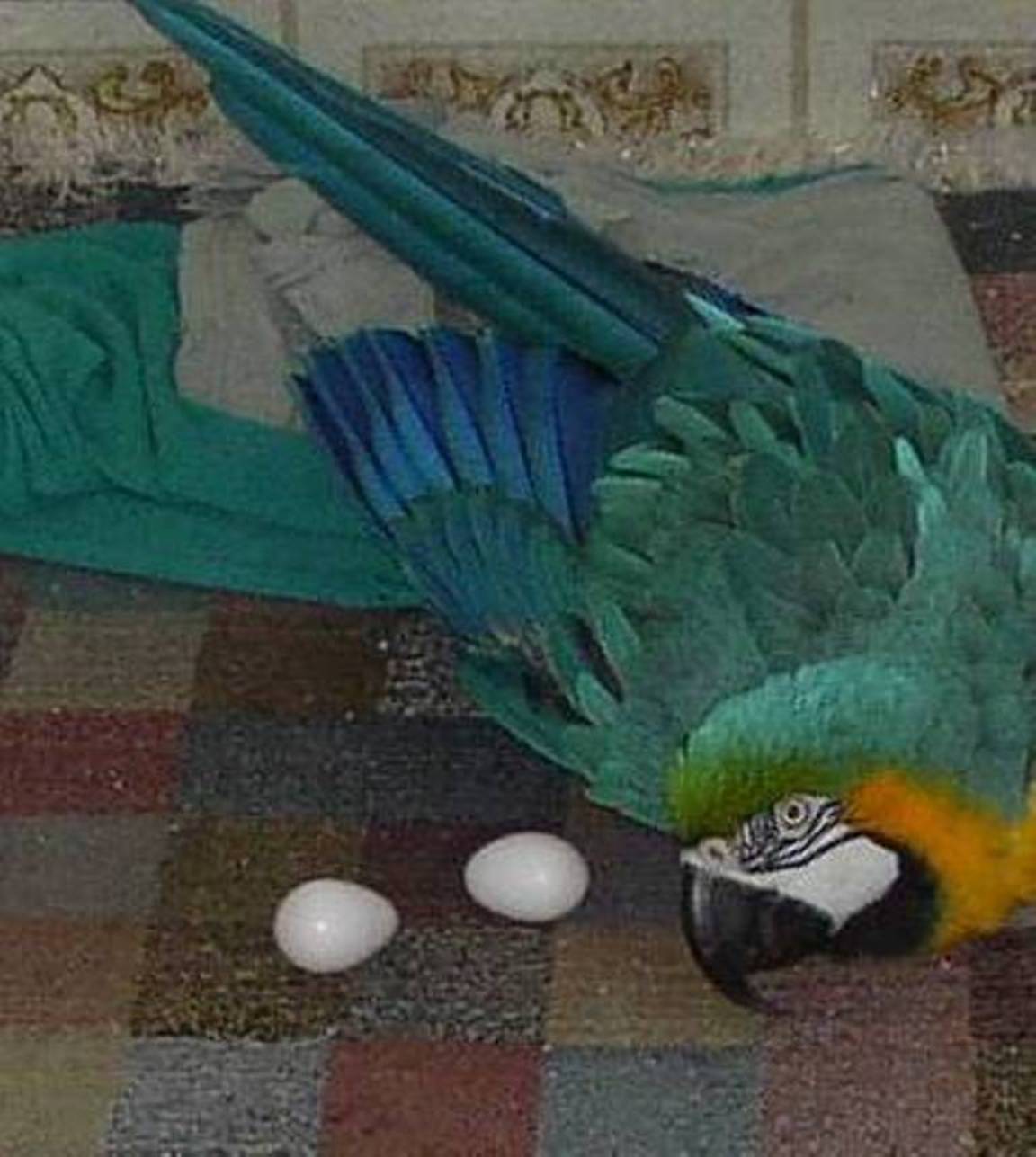
Miss Bubba Boy is a confirmed female Blue and Gold macaw that we rescued from a breeder who needed a male macaw for his breeding facility. Bubba's original owner was so sure that Bubba was a boy he never bothered to have her sexed. We did. We paid fifty bucks for a DNA test, but we kept her name anyway. She calls herself Bubba Boy! We could have saved the money! Within a month, Bubba laid her first clutch of eggs. She has laid two clutches of eggs since she's been with us. Bubba immediately bonded to my partner, and tried to attack me every opportunity she got for about two years. Eventually we reached a detente. Now Bubba even hucks for me. Plus she knows that no one appreciates looking at her wings as much as I do!

Roxanne

Our Diva parrot and Greenwing macaw Roxanne was named for The Police song. She even knows the lyrics! Roxanne also knows the lyrics to the Gene Autry song You Are My Sunshine. We recorded a duet with Roxanne and Gene Autry. The Gene Autry Museum in Los Angeles was so impressed, they sent us a nice note.


We acquired Roxanne when we answered an ad in the Sunday classifieds. Roxanne's owner got divorced. Got remarried. Was moving out of state. The new wife gave him an ultimatum: Her or the parrot. We don't think he made the right choice. The first time we met Roxanne, she immediately stepped up with both of us. Roxanne's owner was astounded. She had refused to step up with any of the other people that had answered his ad. He dropped her asking price in half, and we came home with our first parrot.


We only ever intended to get the one! The rest, as they say, is history.

Wednesday, June 29, 2011

Bathing Your Parrots


Our female Congo African grey parrot Arua loves to bathe in her water dish. Taking a shower? Not so much.


Some parrots love to bathe. Some parrots would rather not. Bathing is an essential part of feather care and maintenance. Most parrots and other birds naturally take to the water to bathe. Just try keeping your outside bird bath full during those hot summer days! Some parrots are highly particularly about how they bathe. Other parrots are not. Be thankful if you have a parrot that belongs to the latter category. If the former category, just keep plenty of towels and wipes handy. It's another problem entirely if you have a parrot that refuses to bathe. Then you'll need to experiment with different solutions to try to encourage the parrot to dip its toes in the water.


Of our eight parrots, four of our five macaws love to take showers with us, perched on our hands and arms in the bathtub. Our foster Ruby macaw Mr. Cracker probably would as well, if we could get him to step up. Instead, he prefers to bathe in his water dish. Somewhat modest, he doesn't like people watching him bathe, so if we're in the room when he wants to take a bath, he'll politely pipe up with a Bye, Bye, until we get the message, and leave the room.


Our male Goffin's cockatoo Kid Kadra loves to bathe and would probably take a bath daily if we were up to it. His preference is a spray bottle on the shower rail in the bathroom. Barring that, he'll sit on the shower rail and bathe in the spray of the macaws taking showers.


As our male Goffin's cockatoo Kid Kadra demonstrates, sometimes a bath just needs the right soundtrack! If a shower is not in the offing, maybe a parrot just needs to settle for a soak in the nearest tub, or water dish, especially on those hot summer days:


Our female Timneh African grey parrot Tillie will tolerate a spray bottle on the shower rail. Usually she'd rather not. On those occasions that Tillie will take a bath, she can get quite animated:


On those rare occasions when Tillie really really wants to bathe, no parrot enjoys a bath as much as she does!


For sheer entertainment value, we can't beat our female Congo African grey parrot Arua. Arua loves to bathe. But in her water dish, not the shower. She's very large for an African grey. Our avian vet Tracy Bennett called her fat the very first time she met Arua, but that's another story entirely. Plus, her water dish is very small. A Number 1 Fenix crock. That's a lot of parrot in a confined space. Much water displacement:


We've tried putting out large water dishes and trays for her to bathe in. She ignores them. So now, when she jumps into her water dish, we just lay out the towels along the side of her cage.


If you have a parrot resistant to taking a bathe, two things you can try. If you can take a cage outside on the porch or in the yard on a warm day, let a hose spray across part of the cage, but leave room for the parrot to retreat to if the bird doesn't want to get wet, or wants to get out of the water. If you're not able to take the parrot outside, get a parrot perch for your shower, and let the shower flow over part of the perch so the parrot can choose to take a dip or not. Just keep trying different methods until you find one that works for your parrot.


Of course, some of our parrots will tell you that the best part of any shower is the blow dry following the shower!


Our male Blue and Gold macaw Aboo is a cowboy when it comes to taking baths. He'd rather not, until he becomes so gamey even he can't stand it. But the blow dry? Just loves it!


Happy Bathing!

Monday, June 13, 2011

How Does Your Parrot Communicate With You?

How do you communicate with your parrot? More importantly, how does your parrot communicate with you? How does your parrot for example, tell you when he or she is hungry or thirsty? With our parrots it's simple. They tell us. In plain English! At least some of them do.


When our female Congo African grey parrot Arua wants food she tells us: Apple. This is actually a change from her original word for food: Hot. So when it comes dinner time she starts asking for Apple. And when we give her her food dish, she confirms that it is in fact Apple. Of course Apple, or even Hot, is certainly better than the extreme pressure that she used to put on us when we were fixing birdie meals, when she would  insistently repeat: You Done Yet?


Our male Blue and Gold macaw Aboo draws a distinction between people food and parrot food. When he wants people food Aboo says: Hot. When Aboo wants parrot food he says: Crack. Presumably Crack is short for cracker, and not the other thing. But Aboo is a rescue bird, so no telling! When Aboo is thirsty, he occasionally says: Water.


Our female Blue and Gold macaw Bubba Boy (no, we didn't name her) also tends to say Hot when she wants to be fed. Makes us curious if they learned this word independently of each other, or learned it from each other. We're pretty sure Aboo started saying Hot when asking for food before the others picked it up.


Sometimes but not always, our foster Ruby macaw Mr. Cracker simply says: Food when he wants food. No mistaking his meaning there. Mostly when he's hungry he dances for his food. If he's really hungry he starts whacking his treat box.


Since we originally posted this story, Mr. Cracker has come up with a new phrase we've never heard before, and almost a complete sentence by macaw standards. We like to sleep in on weekends. One Saturday morning recently we awoke to Mr. Cracker calling out several times: Cracker. Food. Come here! Nothing like waking up to a demanding macaw.


A lady of few words, our Hyacinth macaw Princess Tara will on a rare occasion say Water when asking to drink water from the kitchen faucet. We all know that the best water in the house comes from the kitchen faucet! When she's hungry and wants to be fed she just starts honking, and anyone who's been around a honking Hyacinth macaw knows how ear-splitting that can be!


So that's five out of eight parrots in our flock that can actually ask for food or water by simply asking for food or water! So how about you? How do your parrots communicate to you that they are hungry or thirsty? Or any of their other needs and desires. Both of our Blue and Gold macaws for example, say Let Out, or Let Me Out when they want out of their cages.


Of course we're partial to our littlest parrot, our female Timneh African grey Tillie. When she wants our attention she doesn't scream or honk. She just pipes up in the sweetest little voice and says: Hi Sweetie! It's Me!