Showing posts with label Feeding Parrots. Show all posts

Friday, July 6, 2012

Easy No Fuss No Mess Parrot Corn on the Cobb

Our parrots love corn. We're betting your parrots do as well. Are you tired of raking corn husks off of the kitchen floor when you're done shucking the corn cobs. We know we are. So we were thrilled to discover an easy no fuss no mess microwave method for preparing the corn. And did we say the best part was: No Mess!


Start with your basic ear of corn:


Place unadulterated ear of corn in the microwave.
Heat on High for three (3) minutes.


WARNING: The ear of corn is going to be HOT when it comes out of the microwave!
Hold the ear of corn with an oven mitt or pad.
CAREFULLY! With a very sharp knife slice through the ear of corn just above the butt of the ear.
Try to keep your fingers intact!


Now here's the magical part:  Grasp the opposite end of the ear of corn. Remember: It's still hot! Peel the husk back. It should peel off intact, husk and silk together. Talk about magic!


Voila! No mess.


Slice and Serve.
Bon Appetit!


Tuesday, January 17, 2012

It's Just Nuts! Bulk Nuts for Parrots and People

With the holidays behind us, this is a great time of year to stock up on bulk nuts in the shell, both for you and your parrots. Bulk nuts in the shell may still available in major grocery stores and supermarkets, usually in the produce section. You might even snag some great deals from produce managers wanting to clear out their stocks of bulk nuts. Any extra nuts that you get simply put in airtight containers and freeze. The nuts will keep in the freezer for long periods of time. Once thawed however, we don't recommend refreezing.


Walnuts


The form of vitamin E (gamma-tocopherol) found in walnuts is unusual and particularly beneficial. This form of vitamin E has been found to provide significant protection for the heart. Walnuts also contain antioxidants not found in any other foods, and unlike other nuts, are rich in the plant-based source of omega-3 fatty acids.


Almonds


Almonds are one of the most nutritionally dense nuts. They are among the richest sources of vitamin E and provide an array of minerals and antioxidants. There may be more than twenty different antioxidants in almond skins alone! Almonds are richer than eggs in protein: a quarter-cup contains more than seven grams.


Pistachios


Pistachios are one of the lowest-calorie, lowest-fat nuts and among the highest nuts in antioxidants. They are an excellent source of B vitamins, copper and manganese, which are important for keeping blood sugar stable, protecting bones and nerves, and helping metabolize fat and cholesterol.


Pecans


Pecans contain more than nineteen vitamins and minerals. They also contain different forms of vitamin E called tocopherols, which have been shown to decrease bad (LDL) cholesterol by as much as one-third. Pecans are also a rich source of oleic acid, the same heart-healthy fat found in olive oil.


Hazelnuts


Hazelnuts have the highest content of a plant compound (proanthocyanidin) shown to decrease the risk of blood clots, heart disease, cancer and other chronic diseases. Hazelnuts also rank number one in a B vitamin (folate) essential for preventing birth defects and may help to reduce the risk of heart disease and depression. Doctors and herbalists once used hazelnuts to treat the common cold, persistent coughs and even baldness.

Cashews


Like pecans, cashews are a very good source of the beneficial fat oleic acid and minerals such as copper, phosphorus, and magnesium, which are important for bones, muscles, and stable blood pressure.


Nuts for Health: Eating nuts actually is associated with weight loss! Studies have found that people who ate nuts at least twice a week were much less likely to gain weight than those who almost never ate nuts. According to the U.S. Food and Drug Administration, eating a handful of nuts a day may reduce the risk of heart disease. The plant sterols and good fats in nuts — monounsaturated and polyunsaturated fats — are believed to lower bad (LDL) cholesterol levels. Nuts are a source of l-arginine, a nutrient that may help prevent blood clots. Much of the antioxidants in nuts is in their skins — for example, that's where about ninety percent of the antioxidant-rich phenols in walnuts are stored. Most nuts contain a good supply of vitamin A and B vitamins. Many nuts contain vitamin E, which is important for preventing plaque in arteries and is good for skin, hair and nails. Many nuts are high in potassium, calcium and magnesium, minerals important for healthy blood pressure. In multiple studies, these minerals have a much greater impact on blood pressure than salt.


Nuts for Protein: Nuts are protein-rich but they're not complete proteins because they don't contain all the amino acids. Combining nuts with grains, beans, or vegetables such as greens or broccoli with other amino acids creates a complete protein. Unlike protein from animal sources such as meat and eggs, which have an acidic reaction on the body, most nuts have an alkaline reaction. (Walnuts, peanuts and hazelnuts are exceptions.)


The bottom line is: Nuts are good for people, and nuts are good for parrots! As long as they are part of a balanced diet.

Friday, October 21, 2011

Feeding Parrots: Making Toast Française

Are your parrots tired of eating Chop and Mash day in and day out? Make them some real food! Toast Française for example is pathetically easy to make. And your kitchen smells so good after you fry up a batch you won't want to leave the room.


Making Toast Française
(Irresistible to Parrots)


Surprisingly few ingredients are required to make Toast Française. Basically: bread, milk, egg, cinnamon, and whatever you want to use for coating the toast. Crushed pellets, chopped nuts, and cereal come to mind. Our parrots love organic Peanut Butter Panda Puffs! Our parrots are also partial to vanilla soy milk.


1 slice of bread, toasted
1 Teaspoon milk
1 Egg
1/8 Cup Crushed topping
Dash cinnamon


We cook up two slices of toast per meal for our eight parrots, so we double the ingredients, except for the egg.

Our female Timneh African grey parrot Tillie supervising production of one of her favorite dishes. Got to keep an eye on that yolk.

Seriously beat the egg and milk together for about 30 seconds. Really fluff it up! Stir in the crushed pellets, nuts, cereal, or whatever you wish to use, to coat the toast.


Dip the toasted bread in the egg and milk mix. Your parrot will definitely want to supervise this step!


Fry the toast up in a Stainless Steel pan with cooking spray or a touch of vegetable oil. We like olive oil. Let cool, obviously. It's so good you might just want to make some extra for yourself.


Cut up to desired size.


Serve.

Beak Appetit!

Toast Française  is a favorite with parrots large and small. Our foster Ruby macaw Mr. Cracker can't dive into his food dish fast enough to savor his Toast Française!

Sunday, April 17, 2011

Feeding Parrots: Organic Corn and Pasta

Parrots love corn. Domestic or wild, parrots love corn. In South American, macaw parrots will raid corn fields to feast on the ears of corn. Our parrots love pasta. We don't know how universal the parrot love of pasta is, but it's pretty universal with our flock. So our practice is to make a parrot casserole every weekend to feed the parrots for the following week.


We use organic or all natural ingredients as much as possible. The internal system of a parrot or bird is so much more sensitive to toxins than the human system. That's why canaries were used in coal mines! So rather than repeat organic this or organic that, whenever we list an ingredient, just assume the ingredient is organic or all natural.


One of our favorite dishes, which is a big hit with the parrots, is a Southwestern casserole, with corn, corn pasta, black beans, apple, and carrot. We're as lazy as the next person, and we'd rather not spend any more time cooking than we have to. So our dishes tend to require minimal preparation and cooking time. Even if it costs a little more, we tend to buy precooked products. With our dishes for example, cooking usually involves no more effort than boiling the pasta!

Our Timneh African grey parrot Tillie enjoying corn stuffed pasta!

Another corn and pasta dish popular with our flock is corn stuffed pasta shells. This takes a little bit more work stuffing the pasta shells, but the results are artistic as well as tasty!


The beauty of these dishes is their versatility. Whatever ingredients are handy can be added, or whatever ingredients your parrots favor. With the corn stuffed pasta shells we added Great Northern beans which we just happened to have on hand, as well as rainbow pasta for color, apple, and carrot. As Tillie shows above, the pasta shells are perfectly parrot size, and easy for the parrots to hold in their feet. Wondering if the parrots like this dish?


Here's the carnage from Tillie's dish. Note the skins of the Great Northern beans strewn over the counter. No skins for this parrot! And no need to worry about leftovers. These dishes are tasty enough for us humans to eat. Yummy!

Thursday, November 25, 2010

Living With Parrots: Parrot Blogs


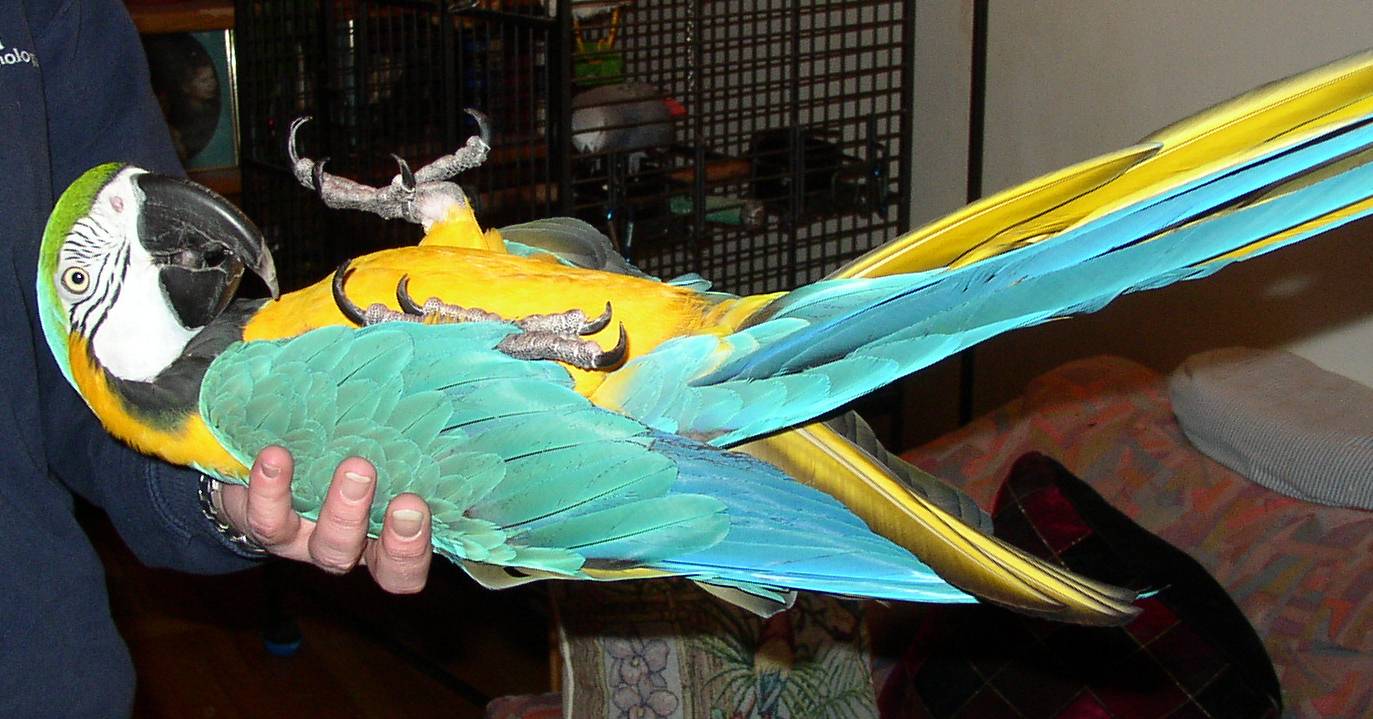
All parrot care should be this easy! Our male Blue and Gold macaw Aboo was abandoned because he was considered unmanageable and unhandleable!

As Patricia Sund of Parrot Nation says: Parrots are "one hell of a lot of work." Whether you have one parrot or an aviary, where do you go to find useful and up to date information regarding positive parrot care and training? As a service to conscientious parrot owners, we are attempting to compile in one place links to the best parrot people currently writing and blogging about parrot care and training. If we have overlooked any parrot writers and bloggers you know of and follow, please let us know so we can add them as well. There is also a community of parrot writers who blog about parrot and wildlife conservation, many affiliated with The World Parrot Trust. We will leave these writers and bloggers for a later blog post.

We'll start with the generalists, and then move on to the specialists:

Living With Parrots

Patricia Sund with two of her Congo African Grey parrots

Since we already quoted her, we'll start with Patricia Sund's Parrot Nation. Patricia Sund's blog encompasses the world of aviculture, and especially the part of the world in which she lives with three African grey parrots in her Florida home.

Shadow, Katherine Rawson's Nanday Conure

Katherine Rawson is a writer and blogger who lives with a Nanday conure, Shadow. Shadow's blog is The Parrot's Point of View. Katherine has published the picture book, If You Were a Parrot.


Betty Jean Craige's female Congo African Grey Cosmo

Betty Jean Craige is a professor at the University of Georgia who lives with a gregarious Congo African Grey parrot named Cosmo, who has published her own book, Conversations With Cosmo.

Rosie Red Bottom: A Comedian With Feathers

From Georgia we travel 6,000 miles across the continent to Alaska where a parrot writer named Donna Hart Mann lives with her Congo African Grey parrot named Rosie Red Bottom and a Cockatiel named Percy. Donna documents her life with Rosie and Percy in her blog African Grey Parrot. Donna recently published a book about Rosie, Rosie Red Bottom: A Comedian With Feathers.

Bryan Xie's Black Capped Conure Kacy

Even farther afield, we travel to Singapore where Bryan Xie lives with his three parrots, Kacy the Black Capped Conure, Kermit the Senegal, and Kiki, an African lovebird. Bryan blogs about life with his companion parrots, including their care and training, on his blog Bryan's Angels.

Coco, a cage free Yellow Crowned Amazon parrot

Robin Cherkas lives in Ashville, North Carolina where she writes the blog Living With Parrots Cage Free, documenting her life with her cage free Yellow Crowned Amazon parrot Coco. As Robin tells me, while she's touched on virtually every topic imaginable regarding parrots and parrot care, her blog's primary focus is simply living with a cage free parrot, the symbiotic relationship between parrot and companion, teaching both the parrot and companion behavior/life skills that promote this harmonious relationship and parrot empowerment.

Rebecca O'Connor with one of her flock mates

In addition to being a parrot person, Rebecca O'Connor is a conservationist, falconer, and writer who lives in Sacramento with her flock including Ty, an African Grey parrot, Bali, a Red-Bellied Parrot, Loki, a Senegal, as well as two falcons and a Brittany. Rebecca writes about her flock on her blog, Heckled by Parrots. Rebecca has documented her career in falconry in her recent memoir Lift: A Memoir. We await a sequel about her life with parrots!

No doubt we have overlooked many parrot bloggers. Please forward their names to us so they can be added. From the generalists we will turn to the specialists. A future blog post will focus on parrot writers blogging about parrot care, training, nutrition, and flying. Stay tuned!

Saturday, July 24, 2010

Feeding Parrots The Twelve Dirtiest Fruits and Vegetables Which Should Only Be Purchased Organic

With farmers markets and produce stands overflowing with fresh fruit and vegetables here at the peak of summer, the temptation exists to grab the brightest and freshest fruits and vegetables to bring home to feed your parrots. But are all fruits and vegetables equally safe to feed to your parrots? Fortunately for parrot people and others, the Environmental Working Group produces a list of the twelve dirtiest fruits and vegetables to watch out for, fruits and vegetables that are most heavily impacted with pesticides and other contaminants. These are fruits and vegetables that should only be purchased organic, or simply avoided:


Along with the list of the twelve dirtiest fruits and vegetables, the Environmental Working Group also provides a list of the fifteen cleanest fruits and vegetables, that are safe to consume even if not organic.

Saturday, July 3, 2010

Feeding Parrots

What goes better with a movie than popcorn?
Especially if you're watching Wild Parrots of Telegraph Hill!

We are pleased to introduce our latest YouTube video series, Feeding Parrots. Parrot owners know that parrots can be finicky eaters. Are you wondering what to feed your parrots for dinner? Some parrots have a choice between Mash and More Mash! Are your parrots literally fed up with Mash? Feed them some real food! Here's a tasty recipe for spicy Mexican rice and black bean burritos with peanut butter sauce. The best part is: There's absolutely no cooking and minimal preparation required! And the burritos are so tasty you can finish off any leftovers yourself! Presented in High Definition, Cooking for Parrots:


To eliminate the need to search YouTube for our other Feeding Parrots videos, we are pleased to append them here. Here's an idea for an easy to fix and nutritious parrot meal. Presented in High Definition, Feeding Parrots: Sunday Dinner:

And how about a meal suggestion for a weekend parrot treat? Here's our original Feeding Parrots video, Feeding Parrots: Sunday Brunch:

Bon Appetit!

Wednesday, June 24, 2009

Feeding Parrots: Sunday Dinner

With our latest Feeding Parrots YouTube video, Feeding Parrots: Sunday Dinner, we officially have a series, to complement our Training Your Parrots, and Parrots Day Out At The Ballard Farmers Market series. If you like our YouTube videos, please subscribe, and you'll receive them automatically as they are posted on YouTube!