Showing posts with label Abused parrots. Show all posts

Wednesday, July 24, 2013

Cockatoos Are Not Suitable to Be Companion Parrots

We are macaw parrot people. Our experience with cockatoo parrots is limited to our male Goffin's cockatoo, Kid Kadra, a parrot juvenile delinquent if there ever was one. Recently, we were contacted by a parrot person living outside of Seattle who is having problems dealing with her cockatoo parrot Conan. Caitlyn is an experienced parrot person. In addition to her cockatoo, she has a flock including three conures, a Meyers, and a lovebird. As Caitlyn notes: I had worked with cockatoos prior to obtaining Conan but had never lived with one. Point being, I didn't go into this with zero experience, but he's the first large parrot that I have owned.

The Ideal

In spite of her parrot experience, Caitlyn developed serious issues with Conan. She contacted us looking for advice. We are putting her story out to the cockatoo parrot people in our audience. Stories like Caitlyn's reinforce our belief that cockatoo parrots simply are not suitable to be companion parrots.

Here is Caitlyn's situation:

I have an umbrella cockatoo, Conan. He is fifteen years old, and we know little of his history but from what we've heard, we assume that we are his third home. I got him from a couple who decided to rehome him because both of them worked full time jobs and, less importantly, he was sort of a screamer.

I brought him home to my parent's house, where I will live for another couple of years to finish my degree. He was cuddly as could be, though we were careful not to cuddle too much, and he screamed about as much as expected. He was in a relatively peaceful room with the other birds at the time. After he started to scream excessively, we brought him into the dining room where there is a lot of activity all day. He stopped for a couple of weeks.

Conan comes out of his cage daily, goes for rides in the car, and is supplied with toys 24/7. He's on a diet of pellets and occasional fresh food. He interacts with all members of the household. It seems as if he should be a rather happy bird. However, his screaming is once again becoming excessive. He used to do it only when nobody was in the room with him; however, now if he's in the mood (which tends to be every other day on average), he will scream regardless of how many people are in the room. He is given a warning, "no screaming," followed by a "time out" where his cage is covered for about a minute or until he stops. We've been doing this for about a month and have seen no difference in the frequency and he never heeds the warning.

Two of us work from home and are on the phone often. We have had to give up on the phone call several times because Conan's favorite time to scream is when we are talking to someone else. If it were only me, I would grin and bear it, but it's both of my parents, too. They have been tolerant so far, but they are reaching the end of their patience.

The more recent big problem is aggression. I'd expect it in the spring, but it is mid-summer now and shouldn't be this bad. He wasn't aggressive before and the previous owners didn't mention anything about it, but in the past month he has bitten me for anything from misplaced aggression, fear, a desire to go and run around on the floor, an aversion to going back into his cage, or just seemingly out of nowhere. He continues to be sweet and sociable most of the time, but I can't have him out without expecting to be bitten at some point. I consider myself to have a high pain tolerance, and I do not get nervous around him, but I can't live with this pattern of aggression for presumably the rest of my life.

Today was the closest I've ever come to a "straw that broke the camel's back" moment. Earlier in the day he had taken a small chunk out of my finger when I attempted to fix his water bowl, but that was of little concern. Later, I came home from errands and opened his cage, intending to take him out for a while. Instead of happily stepping out like normal, he lunged at my hand in a way that absolutely cannot be mistaken for anything but aggression. I've had him use his beak to balance before, and it's very different - this time his crest shot up and his tail fanned out and he jumped at me. On the floor, he ran after my feet, and when I crouched down to try to coax him onto my hand he lunged at my hands once again. I sat on a barstool while he climbed back up onto his cage. Completely confident in the notion that he would now step up from his cage (as he has done for the six months or so that we have had him. Even if he is grumpy on the floor, he always comes nicely from any spot on top of his cage) I walked over and offered him my arm in a deliberately slow way so he would not get excited. With no warning, he jumped at my head/chest/arm and when he missed, climbed back into his cage, proceeding to try to take off my fingers as I locked the cage door.

I just don't know what to do now. If this continues for even another day, it's going to become very hard to take care of him. As I said, I can't live with a large bird that behaves this way and I can't subject my family to it for another two years. I think if it was just the screaming, it might be manageable, but the biting has caused me to seriously think about whether I can keep him. I believe 100% in giving my birds a forever home, but maybe I'm in over my head with Conan. Obviously I'm at my wit's end, since I'm looking up rescues in the area. I really don't want to rehome him just so that yet another family can decide that he is too high maintenance; at the same time, I question whether this is the best place for him. He can't be happy if he's acting this way.

The Reality

I would really appreciate your advice on the matter. Giving him up is a last resort, but we're getting to that point.

Any advice for Caitlyn and Conan? We promise to pass it on.

Saturday, August 25, 2012

Parrots in History: Amazon Indian Practices to Change Parrot Feather Color


As early as the Seventeenth Century, European explorers in South America discovered that Amazonian Indians developed techniques to change the color of parrot feathers from natural colors, mostly green and blue, to colors considered more desirable by the Indians, primarily yellow, or orange. These parrot feathers were highly desired for use in headdresses, leggings, and other ornamentation. To create this color change, Amazonian Indians plucked feathers from live parrots to induce change in feather coloring. This practice was studied by an early Twentieth Century Swiss scholar and explorer Alfred Métraux. His research was published in 1928 in the Journal of the Society of the Americas, Volume 20, under the title:

Une découverte biologique des Indiens de l'Amérique du Sud : la décoloration artificielle des plumes sur les oiseaux vivants

A Biological Discovery of South American Indians: Artificially Recoloring Feathers on Live Birds

(Note: The translation from the French text is mine, and any faults with the translation are mine alone.)

Alfred Métraux

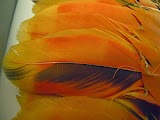
Observed by European explorers, this traditional method was used throughout the Amazon to alter feather color on parrots by repeatedly plucking green or blue feathers, and applying various substances to the parrot skin. New feathers reportedly grew back yellow-orange, sometimes with red or pinkish areas near the vein. In some of the feathers the reddish coloration occurred in a stripe-like pattern. In other cases, the feathers showed irregular areas where the feather is blue or green (on one side of the vein), or in some cases the yellow feather has a green shaft with surrounding green areas. We wrote about this Amazonian Indian tradition in an earlier blog post.


According to Alfred Métraux, the presence of flocks of parrots in the vicinity of the Indian tribes allowed them to be plucked and provided the raw material for crowns, caps, collars, and leggings. The Tupi Indians of Brazil were not content to pluck the feathers of captured birds. They attempted to change the color of the living birds’ natural plumage. The Tupi Indians coated the feathers with frog’s blood to make green feathers grow yellow.

Changing feather colors increased their value and price, either for sale or use in their festivals. Tupi Indians caught live toads which they stung repeatedly with thorns. The toads were cooked in a pot with chili pepper and red dust called chica, creating a varnish. The Indians tore feathers off of parrots and applied the varnish by inserting the tip of a stick in the feather holes in the skin. The parrot did not cease to suffer for several days. After some time the parrot resumed growing feathers, so beautiful they were a subject of admiration to see the beauty and elegance with which they grew. We noticed red spots on the feathers on a yellow background.

South of the Amazon this practice of plucking was rare, found only among the Arawak Indians.  Alfred Métraux quoted a Seventeenth Century report:

The Indians tear the tail feathers and wing feathers of blue parrots, apply in the wounds of the skin toad juice and cover with wax. This way, they manage to regrow feathers with a bright red color they never lose.

The Bororo Indians rubbed the birds they plucked with the sap of a tree.

For the Indians of Guyane, one of the most flattering colors in the eyes of men and women is yellow. There are not enough parrots in this country whose feathers can meet their needs. They discovered the art of turning green feathers into yellow:

They take a live parrot and tear feathers they want to become yellow. After plucking they apply a plant root dye which has the color saffron. They rub the dye hard with their fingers, almost like they wanted to bring out the blood. As feathers regrow, any new green feathers are plucked again and the process restarted. With this technique they manage to make them all yellow.

The Puinav Indians to color parrots in yellow made them eat the fat of fish common to the region. This fat is yellow. The feathers of the parrot that feeds on the fat gets smudged yellow and eventually takes on this color.

Alfred Métraux quoted Alfred Russell Wallace’s 1892 account of life among South American Indians:

They pluck the birds they want to dye, and the fresh wounds are inoculated with a milky secretion of small frog or toad. When the feathers grow back they are bright yellow or orange, without any mixture of blue or green which is the natural coloring of the bird. If the new plumage is torn it is said to regrow in the same color without needing to redo the operation. The feathers are renewed but slowly and it takes a large number to make a tiara, which is why the possession of such finery is such a big deal.

An historical tradition or not, we would call this practice animal cruelty. Unfortunately this tradition of plucking parrot feathers among South American Indians is not confined to the dark reaches of the historical past, but continues to this day, and is the object of continuing study by researchers.

Sunday, August 19, 2012

Extreme Parrots

Extreme Parrots! Extremely Discouraging!


Let us start by stating that we believe that parrots should be allowed to be, simply stated, parrots! It's an open question to us whether parrots are suitable to be pets. Any parrot person who is honest will admit that Cockatoo parrots are not. Suitable to be pets, that is. We are old enough to remember the Cockatoo craze resulting from the 1970s Robert Blake television crime series Baretta, with his faithful Cockatoo parrot named Fred. We can only imagine how many Cockatoos were discarded, abandoned, and neglected after the initial television induced infatuation wore off.

It is our experience working in parrot rescue that parrot rescues and sanctuaries are populated by Cockatoos more than any other parrot. We were less than thrilled recently to learn about the appearance on the reality television program America's Got Talent of a new bird whisperer (we use that term pejoratively) working under the nom de guerre Extreme Parrots, by the name of Clint Carvalo. We don't watch reality television, and very little television at all. Running a parrot rescue, we have enough reality in our life to deal with. We were made aware of Extreme Parrots by the effusive postings about the program on Facebook by parrot people who should know better.

Extreme Parrots purports to use only abandoned and abused parrots. Acquired presumably from parrot rescues and sanctuaries. Which begs the question: What parrot rescues and sanctuaries in their right minds would provide parrots for entertainment purposes? We don't have a clue if Extreme Parrots won their heat and advanced in the America's Got Talent contest? Or what their next bird trick would be if they did. We only know that people who should not under any circumstances be allowed to have parrots will acquire parrots in an attempt to duplicate the tricks they see on television. Parrots will be lost, hurt, discarded, and abandoned in the attempt. Anyone who pretends otherwise is an idiot!

We can wonder how many parrots were lost or discarded in the attempt to perfect this one particular bird trick? We're not even sure if it's real, or computer enhanced. Nonetheless, there will be consequences for parrots in the real world because of the use of parrots on reality television. And the consequences, for parrots and parrot rescues, will not be good.

Wednesday, January 25, 2012

Cage World and Commercial Parrot Abuse

Would you like to know how not to treat a parrot? Debbie from Mesa, Arizona's Cage World will show you, if you can bear to watch. Fair Warning: This video contains disturbing images, made even more disturbing because Cage World clearly believes these are appropriate methods to handle your parrots!


This archaic and outdated training methodology is known in the dog training world as Positive Punishment. In the parrot training world, we just call it Animal Abuse! Common decades ago, these training techniques are still employed by so-called parrot trainers from BirdTricks.com to Debbie here at Cage World. Every parrot person who believes in Positive Reinforcement should read respected parrot trainer Sid Price's scathing critique of BirdTricks and Positive Punishment.

Cage World is located at 2110 W. Southern # F, Mesa AZ 85202.

If you would like to share your displeasure of Cage World's outdated parrot training techniques, here is their phone number: 480-833-4001. Cage World's email address is: questions@cageworldaz.com. Cage World can also be found on Facebook.

Sunday, November 13, 2011

Words Escape Us! How Can Anyone Do This to a Parrot?

Francine is a presumed female, Very Special Needs Blue and Gold macaw parrot, in need of a home in the Seattle area with a very special parrot person, someone with prior macaw experience.


Francine was surrendered to Zazu's House Parrot Sanctuary outside of Seattle, with no history. She arrived at the sanctuary with broken wings, broken feet, and seriously underweight. She has severe plucking issues. She needs a home with an experienced macaw person, who can provide the special environment and extra care that Francine needs to thrive and flourish. Francine comes with no history and no records. Nothing is known about her background or her age.

Because of her broken wings and broken feet, Francine can not fly or climb.

This is as much as Francine is able to extend her wings.

If you are interested in adopting Francine,
please contact Northwest Parrots Fund.

Tuesday, October 18, 2011

Disposable Parrots

The Truth About Parrots: Best Friends Animal Society


Parrot breeders are a strange lot! If you visit just about any online parrot forum, say Patricia Sund's Parrot Nation, you'll run into parrot breeders in total state of denial (and we're not talking about a river in Egypt). Trying to argue with a parrot breeder about the companion parrot overpopulation problem quickly leads to the conclusion that parrot breeders live in a parallel universe where facts and reality do not apply. In this parallel universe, there is no companion parrot overpopulation problem. In this parallel universe the commercial companion parrot trade does not engender wild parrot smuggling across the Mexican border. In this parallel universe, parrot rescues and sanctuaries are full to the brim with unwanted parrots because the rescues and sanctuaries choose to be. In this parallel universe, discarded and abandoned parrots don't get shuffled around to seven or more homes in their lifetimes. In this parallel universe any parrot needing a new home can find one, if you simply work hard enough!

Parrot breeders are full of . . . (I'll be polite) Parrot Poop.

A thirtysomething female Cockatoo parrot named Simba back when she still had some feathers, currently living at Mollywood Avian Sanctuary. Simba is virtually naked now. A previous owner threw her against a wall and broke her keel bone. In spite of her history of abuse and neglect, all Simba wants to do is cuddle in your arms!

We recently had the opportunity to visit Mollywood Avian Sanctuary outside of Bellingham, Washington, north of Seattle. The number of abandoned and discarded Cockatoo parrots residing at Mollywood is truly heartbreaking. These parrots can never be rehomed. Yet parrot breeders keep breeding Cockatoo parrots because breeders and pet store chains have convinced pet owners of the desirability of hand-fed baby parrots.


We were pondering the question of why there are so many abused, neglected, and abandoned Cockatoos and other parrots when we came across a fascinating article on the Bear in Mind blog just published on PsychologyToday.com, Why the Caged Bird Does Not Sing: Captivity and Post-Traumatic Stress Disorder in Parrots and People, by Gay Bradshaw. Traumatologists have discovered that caged parrots exhibited symptoms identical to humans suffering from chronic victimization:


Severely traumatized cockatoos who are rescued and receiving treatment at the innovative sanctuary, Midwest Avian Adoption & Rescue Services, Inc (MAARS) commonly exhibit "rapid pacing in cage, distress calls, screams, self-mutilation, aggression in response to [human and other bird] physical contact, nightmaresinsomnia, and self-mutilation." Parrots are considered to be some of the most highly social species who bond for life and live in complex, closely knit flocks. However many rescued or abandoned parrots who come to sanctuary are so severely traumatized that they will not form relationships with humans or birds.


Parrot trauma is commonly misinterpreted by parrot owners, trainers, and behaviorists. When a parrot beak dives or bites its owner or handler, the action is not seen as a symptom of an unnatural environment, but as bad or problem behavior in need of punishment or training.


When examined through the lens of Complex PTSD, the symptoms of many caged parrots are almost indistinguishable from those of human POWs and concentration camp survivors. These include alterations in emotional regulation, consciousness, and relationship.

Continuing to breed parrots simply introduces wild animals into an unnatural environment, for parrots still are essentially wild animals, unlike dogs and cats that have been domesticated for thousands of years. Parrot training and behavior modification will only ameliorate and not eliminate symptoms of parrot trauma. Parrots will continue to act irrationally to humans, but perfectly rationally in light of this new interpretation regarding parrots and Post-Traumatic Stress Disorder.


Does your parrot misbehave and bite? Just dispose of it and buy another hand-fed baby parrot. Maybe you can train the next one to behave properly. Don't worry about discarding the first parrot. You won't be contributing to the companion parrot overpopulation problem because parrot breeders don't recognize a companion parrot overpopulation problem! To breeders, parrots are simply commodities. No more. No less. They'll keep breeding. If parrot sanctuaries need to build ever more facilities, well, that's their choice.


Here's a modest proposal: Can we at least stop breeding Cockatoo parrots? Cockatoos are simply not suitable to be pets!


Ah, fuck! No point in sugar coating it. Parrot breeders are full of shit! 

Sunday, October 9, 2011

Somewhere Over the Rainbow

The parrot rescue effort needs an anthem, and no song seems to us more appropriate to the parrot rescue effort than Somewhere Over the Rainbow. Too often abused and rescued parrots only find relief and solace after crossing over the Rainbow Bridge.


Somewhere Over the Rainbow is Judy Garland's signature song, written by Harold Arlen and E.Y. Harburg and first sung for the 1939 movie Wizard of Oz.


Our favorite version of Somewhere Over the Rainbow is this one by the late great silver-tongued Hawaiian singer Israel "IZ" Kamakawiwo'ole (1959-1997). We love watching this big guy (he weighed over 750 pounds) play that little ukulele! "IZ" overcame adversity in his life to become considered one of the fifty greatest voices ever by National Public Radio. His anthem provides a ray of hope and cheer for those of us who deal with ugliness and sorrow in our work with companion parrots!

Tuesday, September 27, 2011

What Drives Us to Tears!

This is what makes me crazy!

We received a phone call yesterday that left me at a loss how to respond.


A woman in Eastern Washington rescued a presumed female special needs Blue and Gold macaw named BJ about six weeks prior. The macaw had a broken wing that never received veterinary attention, had plucking and screaming issues, and could be sweet one moment and a terror the next The person that rescued the parrot was quickly able to ascertain the conditions necessary to calm and manage the bird. But after six weeks she concluded that she could no longer offer the parrot the environment that the bird needed. So this person, someone I didn't know and never met, was going to drive the parrot across the state to Seattle the next day, and was phoning to ask if she could drop the parrot on our doorstep! 

Blue and Gold Macaw BJ

BJ lived with her previous owner for about two years. This person's avian veterinarian estimated BJ to be about fifteen years old. BJ lived in a shuttered room, because an open window caused her to start screaming. A television kept BJ company during the day. BJ would only come out of the room at dinner time to eat in the kitchen with the couple that rescued her. During the day, BJ roamed between a play stand and a wire dog crate (see photo below) measuring 18 inches by 18 inches by 30 inches. At night, the macaw was coaxed into the crate with her favorite treats, and closed in and covered for the night!


BJ's previous owner was afraid to handle the macaw for fear of bites. BJ instead picked the woman's forty year old daughter as the one person who was allowed to handle the parrot. BJ would let the daughter scratch her head and would step up on her arm.


When BJ's previous owner acquired the parrot, the bird was living in an outdoor aviary with other macaws. She never left the aviary, and never came indoors, even in winter. BJ was under constant stress, having to fend off the alpha macaws with her. During this time, one of her wings was broken. BJ received no veterinary attention. BJ also developed respiratory problems. Her new owner finally took BJ to a veterinarian where she was diagnosed with aspergillus fumigatus, and treated. BJ is also under treatment for high blood pressure. At some point BJ additionally developed a plucking problem.


BJ seems to have a healthy appetite, favoring Kaytee rainbow pellets, Zupreem pellets, hookbill mixes, and lots of fruits and veggies (cooked and raw). She exhibits a limited vocabulary, saying: Hi BJ, Awwww, Bad Bird, Shut Up! Quiet! and some other phrases.


Two weeks ago BJ moved out of quarantine and into her current caretaker's flock. The change did not go well. BJ became agitated, screamed loudly as in a panic, and started biting without provocation. BJ moved back into isolation, into a room alone with natural lighting and a radio for company. This move seemed to calm the macaw considerably. Unfortunately, because of family considerations, this room is no longer available. Thus we come to the late night phone call to us last night. 


BJ's Home


It's stories like this that fervently cause us to wish to believe in reincarnation. We can only hope that whoever is responsible for BJ's sad state of affairs comes back in their next life as a cockroach! Clearly there are people who should not be allowed to keep parrots as pets. We continue to wonder about the suitability of parrots as pets.


We are happy to report that a home here in Seattle has been found for BJ, on very short notice. We're keeping our fingers crossed!