Saturday, April 13, 2013

Organized Gangs of Parrots Ravage Burma

We just love this story! This article, in its entirety, appears in The Irrawaddy, covering Burma and Southeast Asia:

Organized gangs of local parrots in Pegu Division are leading sunflower farmers to despair. In Toungoo Township, farmers are arming themselves with catapults against the birds, which are attacking their crops and eating all the seeds. “These parrots have come in flocks since the previous month and we are always guarding our plantations with catapults,” one of the farmers told state media. It appears the pilfering parrots may have a coordinated plan of attack, sending out scouting parties. “Only one or two parrots come in the morning and afternoon. But they come in flocks in the evening,” he said.


Wow! Raymond Chandler could not have penned a more crisp and succinct paragraph in the whole history of noir crime fiction. This story cries out to be illustrated with blood soaked photographs of ravenous parrot gangs. Of desperate farmers fighting back with slings and arrows and catapults. But sadly, it is not to be. So we will do our best to illustrate this story with words as we attempt to parse the true meaning of this fierce struggle between parrot gangs and desperate farmers.


What in the hell is an Irrawaddy, anyway? We Googled the term to find out that it's apparently Burma's largest river and most important commercial waterway. Okay. That works for us. Guess that's a good name for a website covering Burma and Southeast Asia.


And what's up with this Burma - Myanmar confusion? You call it Myanmar. We call it Burma. It was always Burma when we were growing up.  Just like when you say Beijing we think Peking. But we digress.


Getting back to the blood soaked battles between parrots and pirates. Sorry, parrots and farmers. What do you suppose the farmers arm their catapults with to beat off the parrot hoards? Sticks and stones? Sunflower seeds? Whatever it is, it doesn't appear to be all that effective by the tone of the article.


Oh for some photos! When we first read this article we immediately thought organized gangs of Cockatoo parrots. Goffin's Cockatoos to be precise. Gawddamn juvenile delinquents! We have one, so we know what we're talking about. But probably the wrong continent. More likely the parrots involved are Indian Ringnecks, indigenous to the Indian subcontinent and Southeast Asia. Specifically the Psittacula krameri borealis, or Rose-ringed parakeet native to Burma.


By all accounts, Indian Ringneck parrots are ravaging London and the rest of Britain, so is it no wonder they are overrunning a little podunk country like Burma:


Twenty years ago we never would have encountered a story this wonderful, or bizarre, in our local newspaper. Got to love the Internets!

Saturday, April 6, 2013

If Life Gives You Lemons, Just Make Your Own Beach


However erudite, well mannered, and communicative our parrot companions are with us, especially our African grey parrot companions, they are still wild animals at heart. It would be better for them and us if they were all living their wild lives out in the wilds of Africa, and wherever else they originated. Unfortunately for them and us they are not and never will. So we just have to do the best we can for them. Make their lives as companion parrots as fulfilling, safe, and carefree as it is possible to make. Then we just hope that in our next lives we don't come back as a parrot stuck in a cage!

Tuesday, March 26, 2013

Good Writing Is Hard Work: Parrot Soup

Presenting Parrot Soup: Desperate Men (Season Two Episode Two)


Featuring Kid Kadra, as Captain Kid Kadra

Writing good dialog is hard work. If you don't believe us, just try it some time. Lauren Bacall's clip from the classic Humphrey Bogart movie To Have and Have Not nicely sums up the model of script writing we strive for: short, terse, concise, to the point! Sometimes the best dialog is no dialog at all, like when Bogey puts his lips together and whistles. As they say, silence is golden.


In case you missed Episode One of Season Two:


Sunday, March 3, 2013

There Was An Old Lady Who Lived In a Shoe

There was an old woman who lived in a shoe. 

She had so many children, she didn't know what to do; 

She gave them some broth without any bread.

Then whipped them all soundly and put them to bed.

Eighteenth Century English Nursery Rhyme


Who You Calling An Old Lady?

Twenty-first Century Timneh African Grey Parrot Tillie

Thursday, February 28, 2013

Ballard Parrot Works


Any parrot person who has flipped through the pages of a parrot catalog recently or checked a website online knows that prices for parrot chew toys are insane. And that's just for the small and medium parrots. Imagine if you live with five macaws like we do! Trying to keep the parrots in chew toys chews through a paycheck in no time at all. And this is for toys that are intended to be destroyed!

So we decided to start building our own parrot toys and trade some of our time and elbow grease for money. We made a small investment in some necessary tools, like a Skill saw for $30 and a Hitachi drill for $40 to start. Got some 2 by 2s and 2 by 4s, some stainless steel chains, and set up a work table in the garage. The Ballard Parrot Works was open for business!

With our macaws stainless steel chains are a requirement. At one time we tried using rope, which lasted about ten minutes under a macaw beak. We like to use ring fasteners to secure the chew toys on the chain because they tend to be parrot proof and they easily come on and off when it's time to add new chew toys.


We can also assemble simple toys with a stainless steel chain and some plastic balls and rings which keep our smaller parrots happily entertained for hours at a time. Our Congo African Grey parrot Arua obsesses over this toy. She finally chewed her first one to pieces, so we assembled another one. We believe that she thinks there must be a way to take the rings off of the chain. She's determined to figure it out!


With time and experience we'll figure out what kind of tools and materials work best for our parrots. For now we're having a great time building toys in the garage. And the results speak for themselves.

Our Greenwing macaw Roxanne eyeing her new string of chew toys as she decides how best to destroy it!

Sunday, February 24, 2013

Snow White and Her Prince Need a New Seattle Area Home

Snow White and Prince Need a New Seattle Area Home

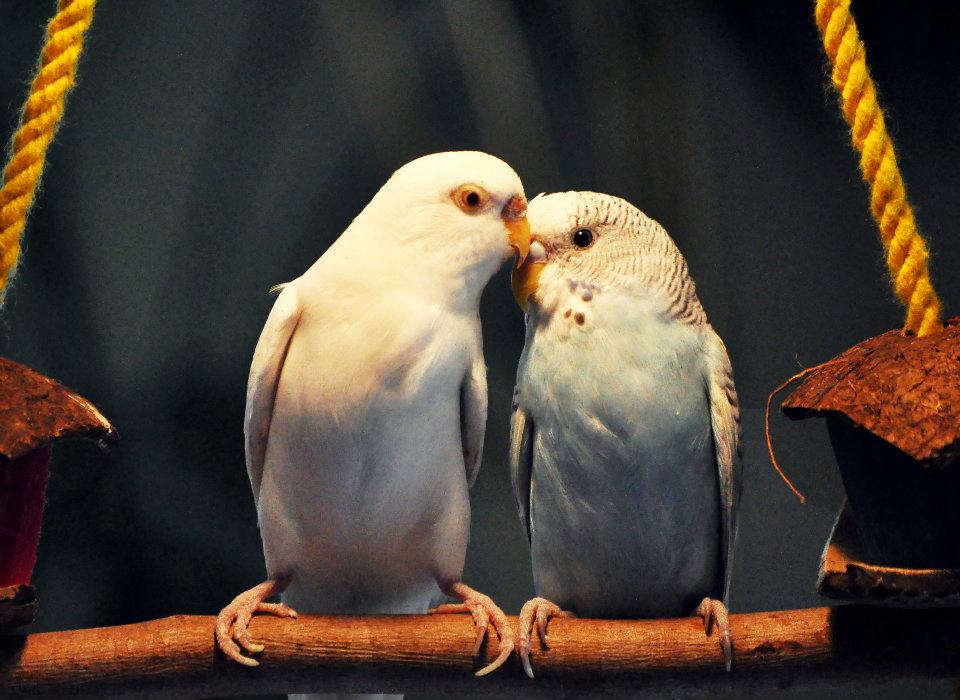
We'll let you guess which Budgie parrot is which. Free to the Right Home. They are a bonded pair so must be adopted together. Apparently they are not a breeding pair. Snow White is actually a found parrot. She was discovered by Prince's owner while fishing on a Seattle dock. Please give Snow White and Prince the home they deserve.

Sunday, February 17, 2013

Kablooie the Quaker Parrot


Kablooie is a presumed male Quaker parrot (Monk parakeet) of unknown age. He has lived in his current home in Renton, Washington, south of Seattle, for sixteen years. Because of changing circumstances his mom needs to find him a new home. According to his parront:

He flew onto our roof on a July 4th and nobody ever claimed him. I don't know the sex, his wings are not clipped and his name is Kablooie -- my son named him for the sounds on the Fourth of July. He prefers women, but is okay with men that speak nicely to him. He does bite. A long time ago he used to sit on my shoulder, but he started taking bites of my skin -- I think preening, so I stopped that. The first couple of years that we had him, he learned about 30 words including barking like a dog and meowing like a cat.  But over time he's lost most of those words, except Good Boy. He usually gets a treat or something that we are eating when he says that.

His cage and bird food go with him. I'm embarrassed to say the cage itself is not very clean. I don't have any place else to put him while I clean it. Kablooie has this one set of plastic chains that he has slept under for years, so he will definitely need to keep those with him.

I think he was abused by a man because of his reaction to males. Kablooie prefers females, or soft talking men. He likes to join in when we laugh. He does squawk a lot to get attention. He learned to bark like a little dog across the street. He likes to meow like our cat, purr, make a sound like a cricket, quack like a duck.

Kablooie sleeps under his plastic chain, has for almost 16 years. It’s important that he keeps this chain. He likes to take a bath in a cereal bowl with a lip. Although he's fully flighted, he's had some bad accidents when he flew, so he doesn't fly much. Kablooie likes bread, carrots, potato chips, popcorn, and nuts as treats.

Kablooie is a good bird. Just loud.

If you are interested in adopting Kablooie please contact Northwest Parrots Fund.