Sunday, October 28, 2012


Sunday, October 21, 2012
You Can't Have Just One!

When Marguerite Floyd asked us to review her new book Cockatiel Lessons (http://www.crackedseedpublishing.com/), we weren't sure what we could possibly learn from a book about the writer's life with a little Cockatiel parrot she named Sugar Franklin. We are macaw people, after all. But we agreed to read the book. And we're glad we did.

Sugar Franklin
How does anyone become a parrot person? Sometimes years before a friend or relative had a parrot, and the memory of this exotic pet sparks a new interest in parrots. Sometimes a parrot picks a person, as it did when a Cockatiel parrot jumped on the author at a Lexington pet store in 1998. For ninety-nine bucks the parrot was hers.
"I'll name you Sugar because I know you'll be sweet and Franklin because my mom's last name is Franklin.” I smiled at the bird. "Well, I guess she'd be your grandmother actually.”
Marguerite's world now revolved around a little Lutino Cockatiel parrot named Sugar Franklin. Some people might consider living with parrots an obsession. Parrot people simply know that parrots, large macaws or small cockatiels, are high maintenance. Parrots are not like dogs and cats. Imagine caring for a pet with the emotional maturity of a three year old child and the intellectual maturity of a five year old. One that never grows up. As Marguerite describes, one lesson learned from living with a parrot is learning that sometimes it's the parrot training the person, not just the other way around.
Another lesson learned from living with a parrot is that parrots, like children, are not cheap:
"Between expensive pellets in cloth-covered bags, new toys, Nutriberries, and books about parrots I soon had no disposable income. I resigned myself to being poor. As long as Sugar Franklin was happy, I was happy."
The thankless chore of constantly cleaning up poop is another, less exotic, lesson of living with parrots.
And then there's the lesson that most all parrot people learn unintentionally. Parrots are like potato chips. You can't have just one! When we got our first macaw Roxanne many years ago, we only ever intended to get the one. But once people realized we had a parrot, they began to offer other parrots to us. For free. The parrots they could no longer care for. Thus began our life in parrot rescue. We now have nine parrots.
Like us, Marguerite discovered she needed another parrot. So she acquired an African Brown-headed parrot she named Charli. And then she rescued another Cockatiel parrot she named Flash. And yet another Cockatiel parrot named Nicholas. Apparently she's stopped accumulating parrots. For now.
The hardest lesson for any parrot person to learn is the lesson of loss. And this is a lesson we know only too well. For us, the hardest part of Marguerite's book to read was the story of Sugar Franklin's decline and ultimate fall. We won't spoil the ending for the reader by delving into the details. Suffice it to say, you might want to keep a box of tissues close by as you finish the book.
Sometimes it seems writing a book review is just as hard as writing the actual book. Cockatiel Lessons is one book we weren't sure we wanted to read. But we're glad we did. And we think you will be too.
Marguerite Floyd is a writer, editor, and poet living in central Kentucky. She holds a BA in English from the University of Kentucky and an MFA from Vermont College. Retired from her job as the documentation manager at the UK Hospital, she now writes whatever she feels like writing, and does freelance editing for many strange and varied people. She also runs Cracked Seed Publishing, which publishes quality works about parrots and other birds. Her real job, though, is catering to her three small parrots' every whim. She is the author of Everyone's Daughter (poetry collection), The African Brown-Headed Parrot and The Parrot Reckonings. You can contact her via her website at www.margueritefloyd.com. Marguerite Floyd's books are available on amazon.com, Barnes & Noble online, and smashwords.com for digital versions.
Thursday, October 18, 2012
Thrilled!

I am thrilled to say I cast my vote to reelect President Barack Obama today! Washington State has total mail-in balloting and we received our ballots in the mail today. Will drop it in the return mail tomorrow. In Washington State mail-in ballots only need to be postmarked by Election Day.
I am also pleased to say that Washington State is doing its part to reelect President Obama. Obama enjoys a FOURTEEN point advantage over Willard Mitt Romney, even after the disastrous first debate.
Did I say how thrilled I am!

Sunday, October 14, 2012
A Rogue's Gallery: Parrot Portraits


Princess Tara, Hyacinth Macaw, The Zen Parrot
Princess Tara really is a princess! Her parents are a Duke and a Duchess.

Roxanne, Greenwing Macaw, Diva Parrot
Roxanne is named for the song, and the name fits her perfectly!
Roxanne is our first parrot and does not believe she is a parrot. She believes she's a 5 year old girl.

Bubba Boy, Blue and Gold Macaw, Alpha Parrot
Bubba Boy is actually a girl. She rules over the flock. Of all the parrots Bubba Boy is most proud of her spectacular wings, which she'll show off to anyone interested.
Most appropriate her portrait showcases her wings!

Kid Kadra, Goffin's Cockatoo, Acrobat of Acrobats
Kid Kadra can fly circles around the other parrots, and he knows it!
He loves harassing the other parrots when they're not expecting it.

Arua, Congo African Grey, Intellect
Arua is our most prolific talker and sound maker.

Mr. Cracker, Ruby Macaw (Greenwing / Scarlet Mix)
Mr. Cracker may very well be a wild caught macaw, believed to be about 45 years old.

Tillie, Timneh African Grey
Our smallest parrot, and a real cutie! Between the two of them, Arua and Tillie have an incredible repertoire of sound effects!

Chromo, Blue and Gold Macaw
Chromo is our current foster parrot, temporarily between homes.
Sunday, September 30, 2012
Sevita is Looking for a New Seattle Area Home

Sevita's wings are clipped. All of her vet care has been with Dr. Onorati, DVM - Des Moines Veterinary Hospital. Sevita's mom wishes to continue Sevita's care with Dr. Onorati. Sevita boards there frequently and is well bonded with his staff.
Sevita has a distinct preference for women and has always been an only pet. Sevita comes with her cage, perch, and toys. Anyone wishing to adopt Sevita must have prior parrot experience. African Grey parrots are not starter pets. Understand also that African Grey parrots can live fifty years or more. If you live in the Seattle area and are interested in adopting Sevita, please read the Northwest Parrots Fund Adoption Procedures page, and contact Northwest Parrots Fund for screening.

Sunday, September 9, 2012
Don't Break That Door!

Arua

Arua Upside Down
Arua easily picks up the words and phrases she wants to pick up. You Done Yet? I Want Apple! Watch Your Tail. I love YOU! Go poop. Come here missy. Tara, Tara, Tara, TARA! But year after year she refused to say Don't Break That Door! Even though we constantly repeated that phrase to her.
Recently, we heard a couple of garbled words that sounded strangely like Don't Break! Although at first it sounded more like What Break.
As we listened, and as Arua practiced the words, Don't Break became more and more apparent. Success! Now we just need to get her to complete the phrase.

Corky
Saturday, August 25, 2012
Parrots in History: Amazon Indian Practices to Change Parrot Feather Color
As early as
the Seventeenth Century, European explorers in South America discovered that
Amazonian Indians developed techniques to change the color of
parrot feathers from natural colors, mostly green and blue, to colors considered more desirable by the Indians, primarily yellow, or orange. These parrot feathers were highly desired for use in headdresses, leggings, and other ornamentation. To create this color change, Amazonian
Indians plucked feathers from live parrots to induce change in feather
coloring. This practice was studied by an early Twentieth Century
Swiss scholar and explorer Alfred Métraux. His research was published in 1928
in the Journal of the Society of the Americas, Volume 20, under the title:
Une
découverte biologique des Indiens de l'Amérique du Sud : la décoloration
artificielle des plumes sur les oiseaux vivants
A Biological
Discovery of South American Indians: Artificially Recoloring Feathers on Live
Birds
(Note: The
translation from the French text is mine, and any faults with the translation
are mine alone.)

Alfred Métraux
Observed by European explorers, this traditional method was used throughout the Amazon to alter feather color on parrots by repeatedly plucking green or blue feathers, and applying various substances to the parrot skin. New feathers reportedly grew back yellow-orange, sometimes with red or pinkish areas near the vein. In some of the feathers the reddish coloration occurred in a stripe-like pattern. In other cases, the feathers showed irregular areas where the feather is blue or green (on one side of the vein), or in some cases the yellow feather has a green shaft with surrounding green areas. We wrote about this Amazonian Indian tradition in an earlier blog post.

According to Alfred Métraux, the presence of flocks of parrots in the vicinity of the Indian tribes allowed them to be plucked and provided the raw material for crowns, caps, collars, and leggings. The Tupi Indians of Brazil were not content to pluck the feathers of captured birds. They attempted to change the color of the living birds’ natural plumage. The Tupi Indians coated the feathers with frog’s blood to make green feathers grow yellow.
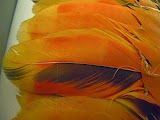
According to Alfred Métraux, the presence of flocks of parrots in the vicinity of the Indian tribes allowed them to be plucked and provided the raw material for crowns, caps, collars, and leggings. The Tupi Indians of Brazil were not content to pluck the feathers of captured birds. They attempted to change the color of the living birds’ natural plumage. The Tupi Indians coated the feathers with frog’s blood to make green feathers grow yellow.
Changing feather colors increased their value and price, either for
sale or use in their festivals. Tupi Indians caught live toads which they stung repeatedly with thorns. The toads were cooked in a pot with chili pepper and red dust called
chica, creating a varnish. The Indians
tore feathers off of parrots and applied the varnish by inserting the tip of a
stick in the feather holes in the skin. The parrot did not cease to suffer for
several days. After some time the parrot resumed growing feathers, so beautiful
they were a subject of admiration to see the beauty and elegance with which
they grew. We noticed red spots on the feathers on a yellow background.
South of the Amazon this practice of plucking was rare, found only among the Arawak
Indians.
Alfred Métraux quoted a Seventeenth Century report:
The Indians tear the tail feathers and wing feathers of blue parrots,
apply in the wounds of the skin toad juice and cover with wax. This way, they
manage to regrow feathers with a bright red color they never lose.
The Bororo Indians rubbed the birds they plucked with the sap of a
tree.
For the Indians of Guyane, one of the most flattering colors in the
eyes of men and women is yellow. There are not enough parrots in this country
whose feathers can meet their needs. They discovered the art of turning green
feathers into yellow:
They take a live parrot and tear feathers they want to become yellow.
After plucking they apply a plant root dye which has the color saffron. They
rub the dye hard with their fingers, almost like they wanted to bring out the
blood. As feathers regrow, any new green feathers are plucked again and the
process restarted. With this technique they manage to make them all yellow.
The Puinav Indians to color parrots in yellow made them eat the fat of
fish common to the region. This fat is yellow. The feathers of the parrot that
feeds on the fat gets smudged yellow and eventually takes on this color.
Alfred Métraux quoted Alfred Russell Wallace’s 1892 account of life
among South American Indians:
They pluck the birds they want to dye, and the fresh wounds are
inoculated with a milky secretion of small frog or toad. When the feathers grow
back they are bright yellow or orange, without any mixture of blue or green
which is the natural coloring of the bird. If the new plumage is torn it is
said to regrow in the same color without needing to redo the operation. The
feathers are renewed but slowly and it takes a large number to make a tiara,
which is why the possession of such finery is such a big deal.
An historical tradition or not, we would call this practice animal cruelty. Unfortunately this tradition of plucking parrot feathers among South American Indians is not confined to the dark reaches of the historical past, but continues to this day, and is the object of continuing study by researchers.
Subscribe to:
Posts (Atom)

