Showing posts with label Amazon. Show all posts

Wednesday, February 21, 2018

The Last Carolina Parakeet

Commemorating Incas, the last known Carolina Parakeet, who died on this date one hundred years ago at the Cincinnati Zoo, ironically in the same aviary where Martha, the last passenger pigeon, had died four years earlier.

Cincinnati Zoo Photo of Incas

The last known wild specimen of a Carolina Parakeet was killed in Okeechobee County, Florida, in 1904.

Incas died within a year of his mate, Lady Jane. It was not until 1939, however, that it was determined that the Carolina Parakeet had become extinct.


John James Audubon, Plate 26, Carolina Parrot, Birds of America

Illustration of a Carolina Parakeet by Jacques Barraband, 1801

Two subspecies of the Carolina Parakeet existed, the Western Subspecies, and the Southern Subspecies illustrated here by John James Audubon

Rare photo of a pet Carolina parakeet named “Doodles”, owned by Paul Bartsch, a zoologist at the Smithsonian Institution

Turnaround video of a Carolina Parakeet specimen at Naturalis Biodiversity Center can be seen here.

The Carolina Parakeet was one of only two parrot species indigenous to the continental United States. The Thick-billed Parrot ranged across the American Southwest and Mexico in prehistoric times. By the 1920s it was pushed into Mexico where it still survives. The species currently is listed as Endangered, with less than 4,000 individuals. An attempt to reestablish the Thick-billed Parrot in Arizona during the 1980s sadly failed.


The Puerto Rican Amazon Parrot can still be found in the American possession of Puerto Rico, where it is listed as Critically Endangered, with less than one hundred individuals in the wild.


Friday, March 31, 2017

Blue Tara; Or, How Is a Hyacinth Macaw Parrot Like a Tibetan Goddess?

Now Available on Amazon


I originally got a parrot because an old black guy with parrots told me it would help me pick up chicks. And I don't mean the poultry kind. Picked out a parrot at this old black guy's bird store here in Seattle that was big, blue, and loud. And a princess. The loudness I didn't learn about until it was too late. But that was the least of my problems. First of all, turns out I didn't actually pick out the parrot. The parrot picked me. Not only was the parrot big, blue, and loud. And a princess. The parrot was a witch. Not a figurative or allegorical witch. A literal witch. A witch of the spell casting kind. The abracadabra kind. A witch with a coffee addiction. Once I entered the bird store the parrot cast a spell. The kind of spell that caused me to open my wallet for a big, blue, loud witch. The kind of witch that didn't abide with girlfriends. The kind of witch that didn't abide with not getting her way. The kind of witch that turned out to be my guardian angel and a proverbial albatross around my neck at the same time. A witch named Princess Tara.

Princess Tara was on a mission to save the world from a diabolically evil shapeshifting cannibal warlord and his zombie minions. She needed the help of a couple of history professors to discover the ancient spells and magic to defeat these ghouls. Me and my colleague and good friend Mike. All I wanted to do was put my failing academic career behind me and roast coffee. Oh, and snag a date with a cute barista I knew. But before Princess Tara could save the world, she needed me to save her from a dumpy little bird store she was stuck in. Too late I remembered the old Chinese proverb, save a life, and you're responsible for that life forever.


Book Two of The Princess Tara Chronicles: The Princess Witch; Or, It Isn't As Easy To Go Crazy As You Might Think, coming this summer. Stay Tuned! And Princess Tara thanks you for your support.


Saturday, March 25, 2017

Blue Tara; Or, How Is a Hyacinth Macaw Parrot Like a Tibetan Goddess? Dead Tree Edition

Princess Tara is thrilled to announce that Book One of the Princess Tara Chronicles: Blue Tara; Or, How Is a Hyacinth Macaw Parrot Like a Tibetan Goddess? Now Available in a Dead Tree Edition. Just click on the link to get your copy:


Princess Tara apologizes for the tree.

Saturday, September 13, 2014

Organized Gangs of Parrots Ravage Los Angeles


This story in its entirety appeared on CBSLA.com September 12, 2014:

A flock of feral parrots is flying and squawking around Echo Park and Silver Lake, making the area known for its hipster ways sound more like a jungle. “It’s loud. You know they’re there,” resident Daniel Merrill said. Merrill took photos of the exotic green birds near Silver Lake and Sunset boulevards. He says a large flock recently woke him up. “They were loud. You can hear from inside the house, definitely,” he said. Kimball Garrett, an expert on birds at the Natural History Museum of Los Angeles, says thousands of parrots have made their homes in Southern California. “They find everything they need here. All the seeds, fruit and berries, nectar, so they thrive,” Garrett said. Garrett founded the website CaliforniaParrotProject.org, which has information about a dozen species that live across the region. The birds were brought here decades ago and were either released or escaped from cages, Garrett said. And, yes, they do get noisy. “Parrots are social birds, and they communicate by screaming at each other, basically,” he said. The birds are loud, but many feel they’re part of the neighborhood just like anything else. “I think people just need to get used to it. It’s a part of nature,” bird watcher Jenna Enns said.

"It's loud. You know they're there. . . You can hear them from inside the house, definitely. . ." My god. Parrots are loud! Clearly a threat to the LA version of Western Civilization as we know it. A large flock of wild parrots recently woke someone in LA up from a deep (probably drug induced) slumber. Yee gawds. And if that's not bad enough, they have everything they need to survive: seeds, fruit, berries, nectar. What's not to like about LA? Is it any wonder there are flocks of wild parrots flying and squawking about?

But the story says nothing about the counter measures to keep people from being awakened without warning. No mention of catapults. Nor sling-shots and arrows and bows. No demands for LA Law to roll in their oversized mine-resistant armored personnel carriers. So maybe it's not that bad. But by god, can't a guy get some sleep for chrissakes?

Saturday, August 25, 2012

Parrots in History: Amazon Indian Practices to Change Parrot Feather Color


As early as the Seventeenth Century, European explorers in South America discovered that Amazonian Indians developed techniques to change the color of parrot feathers from natural colors, mostly green and blue, to colors considered more desirable by the Indians, primarily yellow, or orange. These parrot feathers were highly desired for use in headdresses, leggings, and other ornamentation. To create this color change, Amazonian Indians plucked feathers from live parrots to induce change in feather coloring. This practice was studied by an early Twentieth Century Swiss scholar and explorer Alfred Métraux. His research was published in 1928 in the Journal of the Society of the Americas, Volume 20, under the title:

Une découverte biologique des Indiens de l'Amérique du Sud : la décoloration artificielle des plumes sur les oiseaux vivants

A Biological Discovery of South American Indians: Artificially Recoloring Feathers on Live Birds

(Note: The translation from the French text is mine, and any faults with the translation are mine alone.)

Alfred Métraux

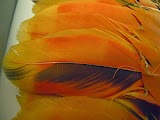
Observed by European explorers, this traditional method was used throughout the Amazon to alter feather color on parrots by repeatedly plucking green or blue feathers, and applying various substances to the parrot skin. New feathers reportedly grew back yellow-orange, sometimes with red or pinkish areas near the vein. In some of the feathers the reddish coloration occurred in a stripe-like pattern. In other cases, the feathers showed irregular areas where the feather is blue or green (on one side of the vein), or in some cases the yellow feather has a green shaft with surrounding green areas. We wrote about this Amazonian Indian tradition in an earlier blog post.


According to Alfred Métraux, the presence of flocks of parrots in the vicinity of the Indian tribes allowed them to be plucked and provided the raw material for crowns, caps, collars, and leggings. The Tupi Indians of Brazil were not content to pluck the feathers of captured birds. They attempted to change the color of the living birds’ natural plumage. The Tupi Indians coated the feathers with frog’s blood to make green feathers grow yellow.

Changing feather colors increased their value and price, either for sale or use in their festivals. Tupi Indians caught live toads which they stung repeatedly with thorns. The toads were cooked in a pot with chili pepper and red dust called chica, creating a varnish. The Indians tore feathers off of parrots and applied the varnish by inserting the tip of a stick in the feather holes in the skin. The parrot did not cease to suffer for several days. After some time the parrot resumed growing feathers, so beautiful they were a subject of admiration to see the beauty and elegance with which they grew. We noticed red spots on the feathers on a yellow background.

South of the Amazon this practice of plucking was rare, found only among the Arawak Indians.  Alfred Métraux quoted a Seventeenth Century report:

The Indians tear the tail feathers and wing feathers of blue parrots, apply in the wounds of the skin toad juice and cover with wax. This way, they manage to regrow feathers with a bright red color they never lose.

The Bororo Indians rubbed the birds they plucked with the sap of a tree.

For the Indians of Guyane, one of the most flattering colors in the eyes of men and women is yellow. There are not enough parrots in this country whose feathers can meet their needs. They discovered the art of turning green feathers into yellow:

They take a live parrot and tear feathers they want to become yellow. After plucking they apply a plant root dye which has the color saffron. They rub the dye hard with their fingers, almost like they wanted to bring out the blood. As feathers regrow, any new green feathers are plucked again and the process restarted. With this technique they manage to make them all yellow.

The Puinav Indians to color parrots in yellow made them eat the fat of fish common to the region. This fat is yellow. The feathers of the parrot that feeds on the fat gets smudged yellow and eventually takes on this color.

Alfred Métraux quoted Alfred Russell Wallace’s 1892 account of life among South American Indians:

They pluck the birds they want to dye, and the fresh wounds are inoculated with a milky secretion of small frog or toad. When the feathers grow back they are bright yellow or orange, without any mixture of blue or green which is the natural coloring of the bird. If the new plumage is torn it is said to regrow in the same color without needing to redo the operation. The feathers are renewed but slowly and it takes a large number to make a tiara, which is why the possession of such finery is such a big deal.

An historical tradition or not, we would call this practice animal cruelty. Unfortunately this tradition of plucking parrot feathers among South American Indians is not confined to the dark reaches of the historical past, but continues to this day, and is the object of continuing study by researchers.

Saturday, March 10, 2012

Tapirage: Plucking of Macaw Parrot Feathers by Amazon Natives

First observed by European explorers in the Seventeenth Century, Tapirage is a traditional method used throughout the Amazon to alter feather color on Macaws by repeatedly plucking green or blue feathers, and applying various substances to the parrot skin. New feathers reportedly will grow back yellow-orange, sometimes with red or pinkish areas near the vein. Identification of these feathers is done visually, but it is not always easy to tell, especially in cases where the color has faded.   


In some of the feathers believed to be the result of tapirage, the reddish coloration occurs in a stripe-like pattern. In other cases, the tapirage feathers also show irregular areas where the feather is blue or green (on one side of the vein, or in some cases the yellow feather has a green rachis with surrounding green areas.


The leading publication on tapirage is in French, published in 1928: Une découverte biologique des Indiens de l'Amérique du Sud: la décoloration artificielle des plumes sur les oiseaux vivants, written by Alfred Métraux.

There are many early European accounts of tapirage written over the past three hundred years. This one is from A. R. Wallace, A Narrative of Travels on the Amazon and Rio Negro, published in London in 1853:

"They were all completely furnished with their feather ornaments, and I now saw for the first time the head-dress, or acangatara, which they value highly.This consists of a coronet of red and yellow feathers disposed in regular rows, and firmly attached to a strong woven or plaited band. The feathers are entirely from the shoulders of the great red macaw, but they are not those that the bird naturally possesses, for these Indians have a curious art by which they change the coIours of the feathers of many birds.They pluck out those they wish to paint, and in the freshwound inoculate with the milky secretion from the skin of a small frog or toad. When the feathers grow again they are of a brilliant yellow or orange colour, without any mixture of blue or green, as in the natural state of the bird ; and on the new plumage being again plucked out, it is said always to come of the same colour without any fresh operation. The feathers are renewed but slowly, and it requires a great number of them to make a coronet, so we see the reason why the owner esteems it so highly, and only in the greatest necessity will part with it."


It appears that Wallace is describing a Greenwing (Red and Green) macaw, or a Scarlet macaw. There are many other descriptions of tapirage, similar to this, throughout the Eighteenth and Nineteenth Centuries. Most are not very descriptive about the type of macaw, although all of them reference plucking blue or green  feathers and rubbing the exposed skin with various substances (sometimes a frog poison - there are also references to certain fats, tree resins, and dyes being used on the bird's skin). It also seems likely they were plucking large areas of feathers at once, and used parrots that were kept in small aviaries at each village.


After reading these historical accounts of the practice of tapirage, all we can think is the natives of the Amazon had some very angry parrots on their hands!