Saturday, April 28, 2018

The Mummy Macaw Parrots


This photo of supposedly 3,000 year old mummified Egyptian parrots has been making the rounds of social media including Facebook and Twitter.

Setting aside the nonsensical idea that South American parrots somehow found their way across the Atlantic Ocean and through the Mediterranean Sea to Egypt three millennia ago, just to set the record straight, they are not 3,000 years old. They are not Egyptian. They are not even real parrots!

This photo illustrates a ten year old art installation by a Belgian artist named Eline 't Sant. A contemporary graphic designer and painter, she works mostly with mixed-media and assemblages. She frequently travels through the African and Asian continents which is reflected in her work.

The installation is kind of cool though. She imagines parrots as archaeological artifacts. She has photos of her art on her website:

http://www.elinetsant.be/

Just click on the Parrots link.

Sunday, April 15, 2018

Coffee Parrot Dot Coffee

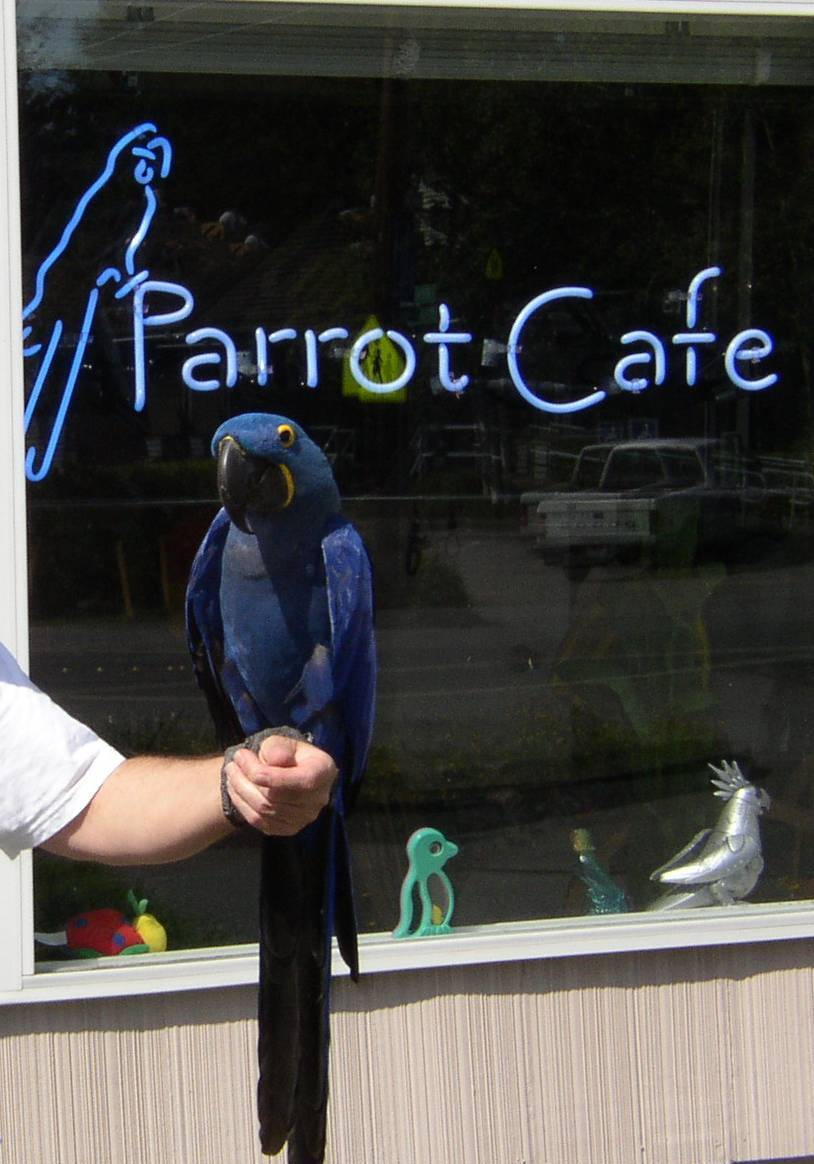
Our Hyacinth Macaw Parrot and Spokesmodel Princess Tara is pleased to announce the launch of her new website CoffeeParrotDotCoffee where her fans can purchase autographed copies of her very own fantasy novel series, the Princess Tara Chronicles, about a parrot that just happens to be a witch, directly from her. Princess Tara also will have available 100% parrot friendly coffee beans roasted to order, and other unique parrotphernalia. Drop in for a visit! We hope to see you there.

With every book purchased, Princess Tara will include one of her flight feathers, which makes for a terrific bookmark.


Saturday, March 17, 2018

Wearing Of the Green

There's green under all that blue. Happy Saint Patrick's Day from our Hyacinth Macaw Parrot Princess Tara!

Image may contain: bird

Saturday, March 10, 2018

Parrot Masks


In 2003 Seattle's old Parrot Cafe commissioned Seattle artist Michael McMullin to create three paper-mache and acrylic masks of the resident parrots. The masks measure approximately six inches wide by eight and one-half inches tall.

Hyacinth Macaw Parrot Princess Tara


Blue and Gold Macaw Parrot Bubba


Greenwing Macaw Parrot Roxanne


Saturday, February 24, 2018

Marshall Towne Mysteries: The Case of the Parrot That Refused To Talk

While cleaning out my closet I found a twenty-five year old manuscript I had completely forgotten about, the first chapter of a Seattle Noir detective novel I wanted to write back in my pre-personal computer days when I was still in graduate school. I had written the first chapter out longhand on legal paper.

Reading it over, it's surprisingly not that bad. Actually pretty darn good. When I finish Book Four of the Princess Tara Chronicles this spring I may just pick it up again and see if I can do anything with it. A detective with a parrot:


Wednesday, February 21, 2018

The Last Carolina Parakeet

Commemorating Incas, the last known Carolina Parakeet, who died on this date one hundred years ago at the Cincinnati Zoo, ironically in the same aviary where Martha, the last passenger pigeon, had died four years earlier.

Cincinnati Zoo Photo of Incas

The last known wild specimen of a Carolina Parakeet was killed in Okeechobee County, Florida, in 1904.

Incas died within a year of his mate, Lady Jane. It was not until 1939, however, that it was determined that the Carolina Parakeet had become extinct.


John James Audubon, Plate 26, Carolina Parrot, Birds of America

Illustration of a Carolina Parakeet by Jacques Barraband, 1801

Two subspecies of the Carolina Parakeet existed, the Western Subspecies, and the Southern Subspecies illustrated here by John James Audubon

Rare photo of a pet Carolina parakeet named “Doodles”, owned by Paul Bartsch, a zoologist at the Smithsonian Institution

Turnaround video of a Carolina Parakeet specimen at Naturalis Biodiversity Center can be seen here.

The Carolina Parakeet was one of only two parrot species indigenous to the continental United States. The Thick-billed Parrot ranged across the American Southwest and Mexico in prehistoric times. By the 1920s it was pushed into Mexico where it still survives. The species currently is listed as Endangered, with less than 4,000 individuals. An attempt to reestablish the Thick-billed Parrot in Arizona during the 1980s sadly failed.


The Puerto Rican Amazon Parrot can still be found in the American possession of Puerto Rico, where it is listed as Critically Endangered, with less than one hundred individuals in the wild.


Saturday, February 17, 2018

Macaw Trail: Macaw Parrots of the American Southwest


Even though macaw parrots are not indigenous to the continental United States, macaws have been a part of Native American culture in the American southwest for at least 2,000 years, according to archaeological evidence.

The best evidence are the actual macaw pictograms carved in rock. A couple of most likely pre-Columbian examples can be found on the aptly named Macaw Trail at Petroglyph National Monument outside Albuquerque, New Mexico. One of the petroglyphs famously shows a macaw parrot holding its foot out:


Another example of macaw pictograms carved in rock, three macaws depicted flying horizontally, can be found at Hovenweep National Monument between Cortez, Colorado and Blanding, Utah on the Cajon Mesa of the Great Sage Plain. This site dates as early as A.D. 1200:


Both scarlet and military macaws were traded into the American southwest from their home range in Mexico more than 500 miles away. Archaeologists believe the parrots, just like today, were kept as pets, displayed as status symbols, and used for ornamentation, feather headdresses being the most obvious example. Archaeologists recently discovered a mummified military macaw head in a cave in a funerary context, buried together with human skeletal remains, outside Chihuahua in northern Mexico. The site is believed to be approximately 2,000 years old.