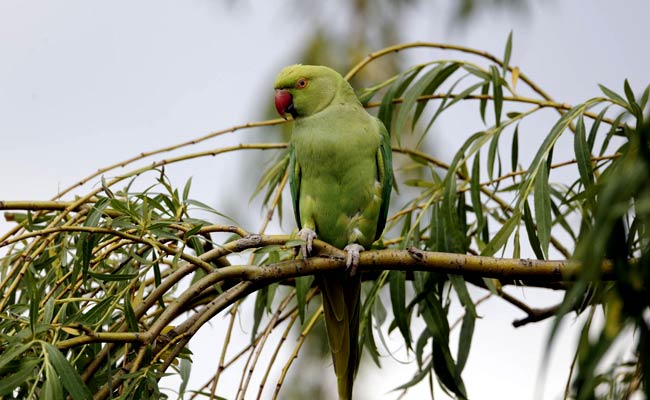
Showing posts with label Indian Ringneck Parrot. Show all posts

Saturday, November 12, 2016

Wild Parrots of London

Wild parrots native to South Asia and North Africa are ubiquitous in today's London, with a feral population according to some accounts reaching scourge levels.


Two millennia ago in Roman London? Not so much. However, there were parrots in Roman London, ancestors of today's British parrots. But those parrots were depictions on exquisite Roman frescos recently discovered buried below the streets of London.

According to a story published by the Museum of London Archaeology:

An ornate fresco that once adorned the residence of a wealthy Roman citizen has been discovered by a team of our archaeologists at 21 Lime Street, in London. We uncovered the fresco six metres below street level, whilst undertaking archaeological fieldwork for a new office development. Dating to the late 1st century AD, and the first decades of London, it is one of the earliest surviving frescos from Roman Britain.

Thanks to a huge Roman construction project, the fate of this rare wall painting was literally sealed in the ground. In AD 100, construction of the 2nd Forum Basilica, the main civic centre for the city and the largest Roman building ever built north of the Alps, began. In advance of construction of the Forum the area was flattened. The painted wall was deliberately toppled and the Forum immediately built over it, incredibly preserving the fresco for nearly 2000 years.

Discovered face down, the fresco was identified from the distinctive markings of the keyed daub onto which the plaster was attached. The fragile remains, surviving to a width of nearly 2.5 metres and a height of over 1.5 metres, were carefully removed from the site by our archaeological conservators, who lifted the fresco in 16 sections. Each section was supported, undercut and block lifted so that soil encased and protected the plaster.

Back in the lab the conservators worked quickly to micro-excavate the soil whilst it was still damp, to expose the millimetre-thin painted surface beneath. The painting is likely to have decorated a reception room where guests were greeted and entertained. . . The central section, on a background of green and black vertical panels, depicts deer nibbling trees, alongside birds [Indian Ringneck Parrots], fruit and a vine woven around a candelabrum. Red panels, bordered with cream lines, surround the main decorative scheme. The fresco was hand-painted by a skilled artist in natural earth pigments, except one area of red on the twisting vine stem which is picked out in cinnabar, an expensive mercuric sulphide pigment that had to be mined in Spain.


It is not inconceivable that some wealthy Roman packed his companion parrot with him on his travel to London. That we may never know. This fresco demonstrates that ancient Romans regarded parrots highly enough to depict them in all their glory even in their most distant outpost of Britain.

Saturday, September 3, 2016

Parrot Created God In Her Image

How is it Adam and Eve had a parrot? Albrecht Dürer (German, Nuremberg 1471 - 1528) The Fall of Man (Adam and Eve) 1504


Native to North Africa and India, Ringed-neck parrots or parakeets are established in Germany today, but in the Germany of 1504? Not so much. In medieval Europe parrot keeping was exclusively the domain of the nobility.

A renowned artist like Albrecht Dürer, whose patrons included Holy Roman Emperor Maximilian I, was used to the rarified atmosphere of medieval courts and most likely saw a parrot or two in his courtly rounds. To illustrate the importance Albrecht Dürer must have assigned to parrots, the Fall of Man was the first engraving that Albrecht Dürer actually signed. And his signature is hanging from the same branch the parrot is perched on.

Saturday, May 7, 2016

Parrots in the Annals of Crime: Parrot CSI India

This story, in its entirety, appeared on the Times of India website, February 26, 2014. Agra, a city in northern India’s Uttar Pradesh state, is home to the iconic Taj Mahal:


Talking parrot ‘helps’ UP Police crack murder case

by Ishita Mishra

A talking parrot has helped the police to crack the case of its mistress' murder after it "identified" the alleged killer

Agra: In a case that seems straight out of an Agatha Christie potboiler, a parrot turned detective and helped nab its mistress' killer.

The question of who murdered Neelam Sharma, 45, and her pet dog, had been baffling the city police for almost a week till they got a clue provided by Hercule, the parrot.

Neelam, wife of Vijay Sharma, the editor of a Hindi daily, was found murdered at her residence on February 20. Her husband noticed a change in the behaviour of the parrot whenever his nephew Ashutosh visited their house after the murder.

"During discussions too, whenever Ashutosh's name was mentioned, the parrot would start screeching. This raised my suspicion and I informed the police," said Sharma.

SSP Agra, Shalabh Mathur, told TOI that Ashutosh confessed to the crime on being interrogated. "We checked his call details and took him in custody. He accepted his crime and informed us that he was accompanied by an accomplice. They had entered the house with the intention of taking away cash and other valuables."

Afraid that his aunt might recognize him, he stabbed her as well as the dog when he started barking. But he hadn't accounted for the parrot who was watching silently.

Editor's Note. There's something karmic in the parrot being named Hercule, after the famous fictional Belgian detective Hercule Poirot.

Saturday, August 22, 2015

Maharashtra Parrot Summoned by Cops for Obscenities

In the annals of parrots in crime, this parrot named Hariyal ranks with the Don Corleones of crime parrots. This story, Say what? Maharashtra Parrot Summoned by Cops for Obscenities, in its entirety, was published on the Press Trust of India website, August 18, 2015:

The woman accused her stepson of teaching the parrot to shower abuses at her.

PUNE:  In a bizarre case, a parrot accused of "hurling obscenities" at an octogenarian woman was summoned to a police station at Rajura in Maharashtra's Chandrapur district today after a complaint against its owner that he had allegedly tutored his caged pet to do so.

The police was at its wit's end after 85-year-old Janabai Sakharkar accused her stepson Suresh of teaching his parrot 'Hariyal', to shower abuses at her whenever she passed by his house.

In order to verify the agitated woman's complaint, the police called all the three involved, including Janabai, her stepson Suresh and Hariyal the parrot to the police station. However, the parrot seemed to have became conscious of khaki clad policmen and kept mum when his cage was brought near Janabai, to see if it would hurl any obscenities at her.

"There is a dispute over land and property between the woman and her stepson. We watched the parrot carefully but it did not utter a word at the police station after being confronted by the complainant," Police Inspector P S Dongre told reporters. (Emphasis Added by Editor)

Although Hariyal never showed any alleged penchant to abuse the woman, the police decided to hand it over to forest department officials, after taking into account the harassed mental condition of the aged woman.

We watched the parrot carefully but it did not utter a word at the police station after being confronted by the complainant," Police Inspector P S Dongre told reporters. This parrot ain't no stool pigeon. The coppers could watch him all day but the parrot wasn't going to snitch on his owner. Don Corleone would be proud.

Saturday, August 8, 2015

Sekar the Birdman of Chennai

This story, in its entirety, appeared on the Bringing Humanity Back website, August 5, 2015. Bringing Humanity Back is an initiative sponsored by the Bollywood actor Varun Pruthi. (Gently edited for consistency and clarity):

Camera mechanic feeds up to 3,000 parrots every day. He spends 40% of his income for feeding up to 3,000 parrots two times a day, In ten years, he might have missed a meal, but never let these parrots miss a meal,

His name is Sekar the Birdman. In this fast moving world, we find space for cold coffees, bling cars, blockbuster movies, end of the season sales, crazy selfies and more. But do we find space for KINDNESS? ‘Impatience’ being the new lifestyle, the rhythm of humanity is missing the beat of kindness, as it is busy catching up with the next second. But somehow, as in all matters of heart, love does find its space through all the situations. Such one inspiring story of Love and Kindness is “THE BiRDMAN”, a documentary of a person named Sekar, living in Chennai on the small yet crowded street of Royepettah. There is something that makes him large, magnificent and, most importantly, humane. How a random act of kindness can bring so much life and so much change to this world stands vividly in his acts. Apart from being a simple camera mechanic winning his bread by his hand skills, what he has been doing for the past ten years will stun you, just the way it stunned us. Take a look!


Saturday, May 9, 2015

When Parrots Go Cold Turkey

The sad lot of the opium addicted parrots of India. This article, in its entirety, appeared on the Times of India website, May 1, 2015:

The parrots who have been feasting on the poppy seeds for the past few months, will not survive without their regular dose of addiction.

CHITTORGARH: Around this time in the poppy fields of Chittorgarh district, many a parrot will perish. The carcasses of these dead birds will be dismembered by crows, that wait for this opportunity. The opium season has ended around 15 days back and the pods have been removed from the fields. These parrots, who have been feasting on the poppy seeds from these pods for the past few months, will now be without their regular dose of addiction, without which, they will not survive.

"It is inevitable," Nandkishore Dhakar, an opium farmer in Sukhwara village of Chittorgarh district is sure that this dance of death will be enacted again. "This phenomenon has never failed," he continues. "These birds break open the pods and devour the seeds still drenched in the milky fluid." This fluid has a cocktail of alkaloids that can enslave the mind. Soon these parrots become addicts and this drug becomes essential for their survival.

"Once we cut the pods, they are deprived of their addiction. They lose their appetite, start behaving strangely and even lose the will to live. Eventually, they just die." It's a sad truth, but for these parrots, their first taste of poppy seeds is also their first step towards death. And death is a certainty , says Nandkishore. "Each one of them will die," he proclaims in a matter-of-fact way.

Of course, for Nandkishore and his ilk, it also means wastage of precious opium, which fetches them huge profit. This farmer is one of the 25 in the village who has been able to hold on to his licence granted by the narcotics department to cultivate opium.

Nandkishore has devoted half-a-bigha of his farm for poppy . From a quintal of opium production, he earns Rs 30,000. When you compare that with other farmers who grow lady finger and earn just Rs 3,000 for the same amount, you would know why Nandkishore continues to nurture poppy plants in the winters despite all the problems associated with it.

Parrots are not the only reasons for loss. Nilgai are a much bigger menace, more so when they come in the darkness of night. "Parrots damage a few pods, but Nilgai destroy the entire crop," Mukesh Dhakar, who lost his opium-farming licence around 10 years ago, informs. "They come in groups, trample crops, eat the plants and run away before we can do anything."

The solution: spend night after night on the field with enough arsenal to scare away these mammals. The narcotics officials are rarely willing to accept nilgai or parrots as excuses to revise the minimum acceptable yield set for the season.

Nilgai too become addicts, says Mukesh. "If a Nilgai gets the taste of opium, he will come every night, disregarding the dangers." But unlike parrots, they are a lot more resistant to the change when the opium season is over. "If the nilgai doesn't get poppy, he will soon start eating other crops. There are no side effects to show," informs Mukesh.

However, for the fragile parrots, this addiction is a matter of life and death. Next season, a new group of parrots will sink their beaks into opium-rich pods and become addicts. And their days will be numbered.

Saturday, April 11, 2015

Rainbow Lorikeet Parrots Eating Meat Leave Experts Astonished, Or, So Perfectly British

Wildlife carer says she is 'horrified.' "I'm absolutely amazed and horrified!" We love this story because it's so British. Even if it is set in Australia.

The following story, in its entirety, appeared on the ABC News Australia website, March 23, 2015.


By Matt Watson

The behaviour of a population of rainbow lorikeets who frequent a backyard feeding station on a property north of Brisbane has left bird experts baffled. The lorikeets are eating meat and Griffith University's Professor Darryl Jones is shocked. Professor Jones, who is researching the impact of backyard feeding on bird populations, said lorikeets usually eat nectar and pollen which they obtain from native plants and shrubs. "I have researched what birds feed on all around the world," Professor Jones said. "I'm up to date with all the kinds of crazy things that birds are eating all over Australia." To see a lorikeet eating meat astonishes me completely. I have never heard of such a thing before. "For years, Bill, who owns the Elimbah property, has put out pets mince for magpies, currawongs and kookaburras. He also puts out seed for vegetarian birds like galahs, king parrots and the lorikeets. He feeds about a dozen birds each day and knows they are spoilt for choice when it comes to food. Bill's property is home to native trees and shrubs, and there is untouched forest nearby. He is happy to offer a few scoops of mince and seed to the birds that come in for a free feed. It was about seven years ago when Bill first noticed the lorikeets eating meat, and they have been eating it ever since. "At first they went for the seed but then they started chasing the other birds away from the meat, which surprised me," he said.

Professor surprised lorikeets are defending meat. Professor Jones said the availability of food on the property made the lorikeet's decision to eat meat mystifying. "It makes no sense at all," he said. "It makes me wonder very strongly that these particular birds, the individuals in the picture, are probably needing some protein. "But the birds look extremely healthy in those pictures." He said lorikeets always get around in pairs and tend to be nasty with other bird species when it comes to food. He said it is not surprising that the lorikeets are chasing magpies and kookaburras away from the meat. "What is unusual is that the food that they're defending is actually meat," Professor Jones said. "That's the strange part about it. "Maybe the lorikeets saw what the other birds were eating and simply decided to try it and liked it. "It's extremely unusual. "Professor Jones believed that lorikeets eating meat had never been documented before. "If it was a genuine idea that lorikeets would eat meat I'm sure it would've come up by now," he said. He said the lorikeet population had increased dramatically in south-east Queensland in the past decade. What once was a common species has now become the most abundant bird in the south east. Professor Jones said people tend to plant native, nectar-bearing plants in their gardens and local councils do the same in their parks, which provides ample food for lorikeets and other birds. He said lorikeets are also being fed by thousands of Queenslanders in backyard feeders. "I would very much like to know if people who put out meat for other birds are getting lorikeets coming and eating it as well," he said.

Wildlife carer says she is 'horrified.' Licensed wildlife carer Fran Sanders has been looking after native animals and birds in Brisbane for 25 years. She has never seen lorikeets eating meat or heard of them doing it. "I'm absolutely amazed and horrified," Ms Sanders said. She has assisted hundreds of people who backyard feed mince to carnivores like butcher birds and magpies and kookaburras. "I've never heard any of them talk about lorikeets coming down and eating mince," she said. "I know when people are backyard feeding, lots of birds will come down and eat because it's easy. "Like us I suppose they get a little bit of a lazy streak and they come down and it saves them hunting or finding food. "They will eat things that aren't really their food." Of the lorikeets eating meat at Elimbah, Ms Sanders has no answers. "Whether it's just a habit they've started because it's there and they've found it, I don't know," she said. "They're not meat eaters, that's for sure. "It's incredible, I'm just so stunned." Ms Sanders said although people enjoy backyard feeding birds, they need to be careful with the food they put out. She said birds do not naturally eat seeds, which can damage their tongues, preventing them from naturally feeding on pollen and nectar. "And meat like pets mince can cause fatty liver disease in carnivorous birds." Professor Darryl Jones would like to hear from anyone who has observed lorikeets eating meat. He can be reached at d.jones@griffith.edu.au

Two rainbow lorikeets tuck into pets mince in a backyard feeder in Elimbah

A population of rainbow lorikeets enjoying a feed of meat while a bird waits patiently on the fence for its turn

Rainbow lorikeets have baffled scientists with their meat-eating behaviour

Rainbow lorikeets take over a backyard feeding station as the bird they kicked out waits patiently on the fence for them to finish

A pair of rainbow lorikeets take turns at getting a beak-full of meat

Saturday, April 4, 2015

Bhopal Man Buys Thirty Parrots Every Month

File this under One Man Can Make a Difference. This story, in its entirety, appeared on India's Daily Bhaskar News Network, March 31, 2015:


Bhopal: Dharmendra can't stand the sight of birds being caged. But there is precious little that he alone can do to make birds free again, fly in the sky.

Every month he purchases around 30 parrots from the bird market. Then he takes the cages to an open space, opens the doors and makes the parrots fly out.


"It gives me immense pleasure to see the birds embracing freedom again, living the life God bestowed upon them," says Dharmendra.

He has a message for all of us: Stop keeping birds as prisoners, let them fly as freedom is dear to all.


Editor's Note: Naysayers will criticize Dharmendra's actions as tantamount to encouraging illegal bird sales. But these illegal bird markets (illegal under Indian law) will continue their activities whether Dharmendra makes his monthly purchases or not. The lives of the thirty parrots every month will be immeasurably improved however.

Saturday, March 21, 2015

Organized Parrot Drug Gangs Ravage Jaipur

The problems India's farmers face are a bit different from the problems American farmers face. This story, in its entirety, appeared in ZeeNews India, March 8, 2015:

Jaipur: Poppy farmers in the Indian State of Rajasthan's Chittorgarh district are facing a unique problem. (Editorial Note: Or, When Good Parrots Go Bad).

Parrots in the Indian State of Rajasthan slurp on the milk oozing out of cuts made in poppy pods

Come March, parrots descend on their fields in large numbers to slurp on the milk oozing out of cuts made in the pods to ripen the yield.

Opium poppy Papaver somniferum with white latex milk

"Once they have their fill they sit on trees and sleep there for hours. Some of them can be seen circling or staggering before falling from the trees due to overdose of opium," says Kishore Kumar Dhaker, a poppy farmer in the Sukwara village of Chittorgarh. Several parrots are also found dead on the ground, some killed in their somnolent state by predatory birds. There are other birds in the area, but parrots seem particularly to be attracted to the intoxicating produce. No one seems to know why.

Farmers are annoyed with the 'winged thieves' as the avian addiction eats into their profit. Moreover, the narcotics department officials look with suspicion at their explanation of a shortfall. According to the terms of their licence, low output can result in the permit being denied in future. Poppy farming is a highly controlled activity since its product, morphine, commands very high prices in the illegal narcotics trade.

Farmers say five to seven per cent of their yield is eaten up by the parrots, despite precautions to frighten them away. "It is difficult to control these parrots. We have to spend hours in our fields to shoo them away," says Bhairulal Jat, another poppy farmer from the same village.

Some farmers use nets to cover their fields, some try to scare them away by beating on tin cans while a few carry catapults with them. "We are not able to sleep fully in the night," says Jat.

Dhaker, whose family has been in opium farming for over four decades, says the birds are addicted to opium because he has been seeing this happening for several years, in March and April, when the poppy seeds are cut to make their milk turn brown for harvesting.

Traditionally poppy farming is carried out in Chittorgarh, Baran, Jhalawar, Udaipur and Bhilwara districts of Rajasthan and usually at the start of March when the plant blooms.

As per the Central Bureau of Narcotics website, opium poppy farming involves lancing and collection of latex from the incised capsule or pod. It is a skilled and laborious job requiring considerable manpower to accomplish the task in a short time span. The capsule is the most important part of the plant as it provides raw opium - a milky exudate. It contains about 70 percent of the total morphine synthesised by the plant.

Sunday, March 15, 2015

Meant To Be Free

We have a soft spot for mushy stories about parrots that have happy endings. This article, in its entirety, written by a columnist under the name Chauburji, appeared in The Nation Pakistan, March 9, 2015:


One of my domestic help hailed from a village in Mohmand Agency. This individual stayed with the family for around fourteen years, serving us faithfully and then bid us goodbye to take care of his meagre land holding, which had become unproductive because of his continued absence. Like all good people, he was a great animal lover – a quality which resonated perfectly with me and my brood.

It was one of those bright sunny afternoons, when he turned up carrying a green ball of mud splattered feathers in his cupped hands and gingerly handed it over to me. I held the little parrot and to my horror found that one of its legs was dangling at an unnatural angle. The nature of the injury convinced me that it had been inflicted either by a callous human or by an animal higher up in the food chain. We gingerly set the limb in makeshift splints and bandaged it, while a small red beak tried weakly to sample our fingers. We then tended to the bird day and night and watched nature’s marvelous healing process take hold.
The latest member of our family gradually adopted me as its surrogate parent. He (the gender discovery came about much later) was named ‘Mian Mithoo’ simply for want of a better name and turned out to be a standup comedian par excellence. His favorite perch was on top of a metal piece of art on the mantelpiece, where he would sit all day long giving ‘I dare you’ looks to anyone who tried to approach him. As I returned from my office and entered the gate, he uncannily became aware of my arrival and emitted strange sounds, turning round and round on his perch. My appearance at the door would generate a fresh burst of energy signified by the flapping of wings and a change of perch from the mantelpiece to my shoulder. Efforts to dislodge the wonderful rascal, so that I could have my sustenance were foiled, forcing me to have my mug of tea and biscuits much like Long John Silver.

As ‘Mithoo’ reached his prime, his flights became longer and more and more oriented towards the window. Around this time we decided to move our residence to another sector and had barely settled into our new home, when an open door provided the sought after opportunity to ‘Mian Ji’. A panicky shout from one of my children was enough to tell me that our green feathered family member had escaped. I rushed to the first floor terrace and saw the familiar figure flying round in circles above the house, oblivious of all the commotion he had caused on the ground. Suddenly he appeared to have decided on a destination and was soon beyond our sight. Utterly crestfallen and sad, I bid him goodbye and rejoined my family downstairs.

As dusk arrived, I began coping with horrific scenarios, where our parrot always ended up becoming cat-meal. I made one last trip to the terrace and stood watching the sun slowly sink behind the Margalla Hills, when something ‘whirred’ out of the gathering darkness and I felt a familiar weight on my shoulder followed instantly by a cold nibble on my ear lobe. I gave a whoop of joy and rushed down the stairs with the news, and a somber evening turned jovial to celebrate the ‘return of the prodigal’.

‘Mian Mithoo’ took flight twice more after this incident, but always returned, till I was advised firmly to clip his wings. I ignored the suggestion on the plea that birds were created with the ability to fly and that neither I nor anyone else was empowered to change what nature had provided. Then one day, carrying ‘Mithoo’ out on the lawn, I heard and then saw a flock of green parrots flying overhead. As on cue, the bird in my hands began squirming and biting in the most frantic manner. Seconds later, realization dawned on me and with a tearful look at my wonderful companion, I released him. A most wonderful thing then happened – ‘my’ parrot raced to join the flock, raising a cacophony of sounds and I watched in awe as the whole group turned back and circled above the house as if performing a final farewell manoeuvre. I never saw ‘Mian Mithoo’ again, but I have been happy in the knowledge that he is amongst his own kind and free as he was always meant to be.

Saturday, January 24, 2015

Sad story of lonely parakeet living in Swansea's Singleton Park - where none of the other birds will make friends with it

Life sucks when you don't have a single friend in the world. This story, in its entirety, appeared on the South Wales Evening Post, January 9, 2015:


Welsh nature expert Iolo Williams has been exploring Swansea’s Singleton Park for his new TV series, where he uncovered all kinds of wildlife, including an exotic bird in need of a friend – and we've got an exclusive clip of the bird ahead of its broadcast.

“When we were filming, I had two or three people say to me, ‘you’re that boy off the telly – have you seen the parakeet yet?’” explains Iolo.

“It took us a while to find the ring-necked parakeet, but we did film it.

“It’s an escapee, native to India and parts of Asia,” he says of the glamorous bird which now calls the park home ­– and is the only species of parrot living wild in Britain.

“It spends a lot of time with the resident jackdaws, and we filmed it trying to butt in with two of them, who weren't interested.

“It’s desperately sad to see it on its own,” he adds of the lonely bird, frantically trying to make friends in its new home.

Correction. Indian Ringneck parrots are not the only species of parrot living wild in Britain. Britain also hosts a small colony of Quaker parrots which the British government is desperately and misguidedly trying to eradicate. We're told that Britain is overrun with Indian Ringneck parrots, so we can only hope with a little luck and a little effort this lonely fellow in Swansea will find a mate.

Wednesday, December 31, 2014

A Sanctuary for Parrots in the Midst of Bustling Chennai

Another year goes. Another year comes. Sometimes it seems the more things change in this world the more they stay the same. Life starts to resemble a scene from the movie Groundhog Day. Or Back to the Future. In these dark and dreary times, to keep from getting totally depressed, it's nice to know that one person can still make a difference. This story, in its entirety, one of our favorite stories of 2014, appeared November 16, 2014, on the website The News Minute:


On a typical evening, Pycrofts Road looks like any other busy main road in Chennai. As motorists and other vehicles speed past an inconspicuous-looking building and pedestrians hurry home on a typical Friday evening, quite a few of them instantly gaze up and a look of amazement passes fleetingly on their faces.

Some of them point out into the sky, while others come to a complete stop outside the building. Some even get down and enquire and as they do, hundreds and hundreds of feathery-little green parrots perched on the terrace of the building and on wires adjacent to it take flight.

In a time where bird sightings in cities are in decline because of lack of natural habitats, the sheer number of parrots that land up every single day on the terrace of this particular building is astounding.

It’s not just magic or plain luck though.

The man behind this green sanctuary amidst an almost-concrete jungle in the city is C.Sekar, who has been feeding these parrots for well, over a decade.

Dressed up in his trademark cap (probably to protect himself from bird poop), Sekar, a full-time camera technician said that feeding the parrots wasn’t something he had planned to do. It had started quite randomly during the aftermath of the 2004 tsunami. When the tsunami struck the east coast of India, villages were washed away, many people living along the sea line disappeared and animals were affected.

“During that time, I found two parrots sitting on my terrace extremely tired and thirsty,” he said. “I fed them that day”. When he continued feeding them as a daily practice, the parrots returned, but with more of their tribe.


The numbers on a typical busy evening are stupendous. “This is nothing. If you see in the morning there are even more parrots. That time there is not much traffic and noise disturbance,” he said.

True to his word, the entire group takes flight disturbed by the sounds of a truck honking in the distance. However, they return to feed on the little mounds of soaked rice placed neatly on the terrace of Sekar’s house.

Sekar buys thirty kilos of rice just for the parrots every day; in all he spends almost Rs. 1000 just on food for his green-little friends each day. But even he couldn’t explain where so many parrots came from. “I think when they migrate from a place to another they pass by here.” He even explained a day on which two parrots were so tired and thirsty that they couldn’t fly onwards on their journey. “They rested on the terrace for a while, had water, and then continued,” he said.

As he talks, he mentions that an unbelievable number of people stop and just stare at the sight before them. Some of them even try to disturb the parrots. “So every evening I stand down making sure no one harms the parrots,” he said.


True to his word, two men passing by the building come to a halt near Sekar. As they enquire why Sekar fed parrots, he gets visually agitated. “Why do these people ask me if it’s a hobby?”

“Do people ask if it is a hobby to feed the poor and the homeless? All these people only want to know how much it costs and whether I have a motive behind it,” he said.

“I live in a rented house. My office is in the same building as my house here, “ Sekar said as he pointed to the same building. “I own a scooter and I have two grown-up children who are settled,” he said explaining his financial position.What does he get out of doing this? Happiness, maybe.

We would think, satisfaction definitely.


Thursday, November 27, 2014

Amid the Swarm of Humans, a Conclave of Parrots

Simply being thankful for parrots. For once, an organized gang of parrots not ravaging anyone or any place! Just parrots that are appreciated for being parrots.

More than a thousand rose-ringed parakeets still find a safe place to roost in the trees near Orion Mall; their presence is a gift

This article, in its entirety, written by Vishakha Chanchani, appeared in the Bangalore Mirror, November 7, 2014:

As I look out through the window of my brother's apartment, I see a host of high-rise buildings against a grey sky. Pigeons hover inside, and make human habitats their own. They find small balconies and settle down on potted plants, making a mess, to the detriment of some plant loving residents!

The Orion Mall in the Brigade Gateway complex in Rajajinagar attracts many human visitors, who gather here in the evenings to enjoy open spaces, the water body, and all the shopping and eating joints. Humans of different ages, shapes and sizes, rub shoulders with each other, taking a break from work and home to enjoy the small pleasures of an evening outing.

Well, allow me to tell you of the other visitors that frequent this place. The flying foxes, the kites, stray dogs, and flocks of parakeets that roost here. The latter gathering together, every evening unfailingly, just as humans flock together in the same complex, in the very same hours!

Wasn't I amazed one evening, when I suddenly discovered that right at the entrance gates of the Mall, a host of rain trees offer their branches to hoards of parakeets? After about six in the evening, I see them arriving in small flocks. One flock after another screeches its way to the crowns of these trees, adding to the green of existing leaves.

The parakeets fall silent as they settle down; the dark takes over, and spots of light from below highlight the glimmering green of the birds. People walking up to the complex may mistake the parakeet-laden trees for leaves. As for the parakeets, they do not seem to mind; not even those lights under the trees that turn this every day event into a well-lit drama. Some watch, whilst some miss the charm altogether.

Maybe, these rose-ringed parakeets are visitors to us; but for these birds, this has been their nightly spot, their home of many decades.

Long before manmade constructions made their presence felt, these areas were populated with trees and shrubs that might have been hosts to more wild life. The parakeets continue to roost here, braving the changing city, glaring lights, a human population, and the traffic that beeps and whizzes by the roads, above which they settle.

Thank god, for their trust, for continuing to make their homes amidst us. Why on earth do we need to trap and cage these birds, when we can invite them to live with us -- allow for trees in our landscapes, and have these special green exchanges? More than a thousand parakeets still find a safe place to roost in, in this part of the town.

When their feathers were molting, I collected them. Feathers flecked with gold, green and blue, brown and graying, straight or slightly curled. Somebody once wrote a poem saying that if you find a feather, pick it up and put it in your pocket -- it's a gift from a bird.

Well Nagarvasi, the presence of winged wild life, in a multiple and urban complex like this, is certainly a special gift. May we always remember, and never forget, to look after it.

Take care till then.

Saturday, October 18, 2014

I am S. Shiva, Parrot Astrologer


Parrot astrology is a tradition that originated in India. In the world of parrot astrology, the parrot (usually an Indian Ringneck Parrot) picks your fortune card and the fortune teller takes the role of an interpreter and conveys the message of the card. The first parrot astrologers originated from the South Indian states of Kerala and Tamil Nadu. Typical tools of trade include a set of 27 fortune cards based on the Indian cosmic system, images of Hindu gods, charts, a notebook, a simple cage crafted out of bamboo or wood, and most importantly, a parrot.

Upon receiving a customer’s name and birth date, the fortune teller taps on the cage signaling the parrot to walk out of the cage along the stack of 27 fortune cards, almost as if it is deliberating on which one to pick. It will then pull out a card with its beak, seemingly at random. Finally it would retreat into the cage. The fortune teller would then reveal the card and interpret the message for the customer, sometimes while referring to his or her notebook.

This profession is explicitly banned in India, along with the ownership of any wild parrot or other animal. Wildlife groups within India such as the Fauna Police are working to put an end to this traditional practice. The parrots involved in this practice are confined in overly small cages, mistreated, mutilated, and malnourished. Yet the practice survives. This article, in its entirety, was published in The Hindu, October 15, 2014:


I learnt parrot astrology from my father. It is our family profession and I have been doing it for the past 14 years. I belong to Tirunelveli but I keep travelling to various town and cities. After Diwali, I plan to leave Madurai and go to Pollachi. Parrot astrology is famous in Tamil Nadu and parts of Andhra Pradesh. Most astrologers come from Kambalathu Naicker community and we worship goddess Jakkamma. The method of astrology is more like tarot reading or soothsaying. We keep a set of 27 cards symbolising as many stars in the cosmic system. And these cards contain pictures of various Hindu Gods and Goddesses. Depending upon the card my parrot picks, I predict the fortune for the customer. Nowadays, people also have images of Mother Mary or Jesus.I have an eight-year-old male parrot and I call him ‘snake babu’. I had a female named Meenakshi which I gave away to a friend. Parrots are trained by elders and the experienced astrologers to pick cards. ‘Snake Babu’ was trained by my father. He had bought him for Rs.500 from Meenakshi temple. I feed my parrot grains like rice and wheat. Parrots that are bought from temples are considered auspicious for the profession. Though female parrots are traditionally used in astrology, male parrots are also used these days. For one reading, I charge Rs.20.* In a day, I get around 20 customers. Once I get married, I may take up some other business as part-time to support my family. My elder brother works in a textile shop in Tirunelveli. Since, it is compulsory for one member of the family to pursue kili josyam, I took it up. However, I like the job.

*At today's exchange rate, 20 rupees translates to 33 cents (US). So a day's wages equals $6.60.

Sunday, August 10, 2014

Organized Gangs of Parrots Ready to Ravage Poland

This article, in its entirety, appeared on the website Interesting News Technology: Unfortunately there is no indication on the website where the author is based, but we'll make a wild guess and say Poland.

Saturday, August 9, 2014

Scientists: invasion of green parrots in Poland is only a matter of time – Polish Radio
These large, green parrots have become popular among farmers because it is easy to tame and willing to learn to imitate Sonically different sounds. It is estimated that in the period 1996-2002 to the European Union brought their 137 thousand. Due to inattention or carelessness of people a lot of pieces found in the wild. can be currently found in parks or on the streets more than a hundred European cities. Most of it is in the UK (a few years ago, the population was estimated at 10-20 thousand. Individuals), Belgium (8.5 thous.), The Netherlands and Germany (after 5,5 thous.). You can not hit as in Greece or Slovenia. Parrots great deal on the loose. They are omnivorous. Quickly discovered what they are feeders (supplanting them great tit and blue tits) and tolerate frosts. – It is said that up to minus 20 degrees Celsius give advice! Please note that cities are warmer, heating pipes are. The potential for parrots is therefore – explains the director of the Institute of Zoology, University of Life Sciences (UP) in Poznan, prof. Peter Tryjanowski (center takes part in the EU’s research program exotic invasion.) great pest and potential health risks Experts point out that where Alexandretta occur naturally are considered to be some of the larger bird pests. In India, destroy crops and plantations of sunflowers and date palms. European cities also pester – parrots are dziuplakami and often burrow holes in the insulation of buildings. The previous European experience of Alexandretta are so difficult that the parrot appeared on a list of one hundred most troublesome invasive species.
For this Alexandretta may be carriers include causing bacteria (including humans) ornithosis, or an acute infectious disease of the respiratory system, and protozoa that cause cryptosporidiosis (gastrointestinal disease). Carry a virus causing Newcastle disease in poultry. Her attack is the loss of the entire culture. 
also cause environmental problems, because in search of places to breed compete with European species, for example. dzięciołami, szpakami and kowalikami. They win as a bigger and stronger, but also because it starts breeding in February, occupying hollows birds that breed later. 
As you read the pages of the EU project DAISIE (Delivering Alien Invasive Species In Europe), yet are unknown methods to prevent invasion or limitation. Natural enemies in Europe parrot is no more than other species.

We can't decide if this article was translated into English from Polish by the author before being posted. Or possibly the article was translated into Chinese from Polish and then into English. This translation is pretty much on par with some of the printed instructions (reputedly in English) that we find with our new electronic devices.

Reading this article, we were thoroughly confused after about a half-dozen sentences. But steadfast our perseverance paid off when toward the end of the article we hit the crux of the problem:

Her attack is the loss of the entire culture. also cause environmental problems, because in search of places to breed compete with European species, for example. dzięciołami, szpakami and kowalikami. They win as a bigger and stronger, but also because it starts breeding in February, occupying hollows birds that breed later.


Her attack is the loss of the entire culture.

Wow, one parrot can bring an entire civilization to its knees! All this because Alexander the Great wanted to invade India. We can see the tee shirts of the time


Αλεξάντερ καταπατά Ινδίας και όλα τα πήρα ήταν αυτό το άθλιο Parrot*

So Western Civilization falls. Then there's the environmental problems to boot. And then the whole thing about breeding earlier and bigger and stronger. Getting the shivers just thinking about it. And if Poland falls, then what? Russia? Alaska? America? Nowhere will be safe. We'll all be speaking Indian Ringneck before they're through.

*Alexander invades India and all we got is this lousy parrot

Wednesday, August 28, 2013

Osama Bin Laden's Parrots: Parrot Lore in Pakistani Art


This has got to be the weirdest parrot story we've encountered so far this year. If ever! A new painting by a young Pakistani artist named Amir Raza features Osama bin Laden staring out at an army of shadowy figures. Each carries a machine gun and has the head of a parrot. This from an article posted on Bloomberg.com of all places, describing the boom in Pakistani art coming out of Pakistan's most violent decade in history. This violent decade has become a boon to Pakistan’s artists, with prices of paintings, number of art galleries in major cities, and frequency of exhibitions all multiplying.

Which got us to thinking. What the hell do parrots have to do with Osama bin Laden? Or Al Qaeda? Or even Islam for that matter?

The parrot heads look suspiciously like Indian Ringneck, or Rose-ringed parrots, the only species of parrot endemic to Pakistan. Actually, four species of parrots: Alexandrine parakeet (Psittacula eupatria), Rose-ringed parakeet (Psittacula krameri), Slaty-headed parakeet (Psittacula himalayana), and Plum-headed parakeet (Psittacula cyanocephala).

We know little about Indian Ringneck parrots, except that they seem to have a fearsome reputation for such a small package. Indian Ringnecks apparently are ravaging Burma, and terrorizing London. Seemingly the perfect parrot to figure in Al Qaeda lore. Thankfully there are no naturalized flocks of Indian Ringneck parrots in the United States outside of Bakersfield, that we know of.

As far as we can tell there is little in the way of parrot mythology associated with the religion of Islam, not surprising for a religion that came out of Arabia. Google was not much help. We couldn't find any reference to parrot lore in Islamic tradition. We did find references to bird symbolism in Islamic tradition on a website called MyIslamicDream.com:

The unknown bird symbolizes the Archangel of Death; a traveller; labour; or a man’s actions or deeds. Big and ferocious or rapacious birds are the kings, chiefs, prominent people, scholars, and rich people or those who make a good living.

Possibly the parrot motif in Amir Raza's Osama bin Laden's Parrots painting symbolizes Al Qaeda fighters as angels of death. We'd love to ask Amir Raza what his painting means. Unfortunately Amir Raza seems to be the Michael Jones of Pakistan. When we Googled the name we came up with pages and pages of Amir Razas.

If anyone has any insight into parrot lore and mythology in Islam, please let us know.